'Him' Succumbs To Silly Metaphors
If you're coming in thinking this is Jordan Peele's next movie, then you'd be fooled like I was. Him has the Monkeypaw Productions name behind it, but Peele is only on as a producer. And boy does it show. Him is like a Jordan Peele fan film made by a frat bro. Granted, Peele's movies aren't exactly very subtle. However, they're not brain-dead. The amount of intellectuality contained in this film is about the same measure of wisdom you'd find in a post-game interview. "Train hard. Go in every day. Give 100%", and still miss your shot!
The premise of the movie is fantastic. With an oversaturated market of inspirational Rocky wannabes, room for dark sports films took a seat on the bench. Incredible films like Requiem for a Heavyweight, Raging Bull, Foxcatcher, and the overlooked Cobb are prime examples of how you can depict the realism behind athleticism. Unfortunately, complexity takes a back seat in favor of simplicity, dumbing down the movie to a degree where a toddler could understand the film's overarching themes. There's nothing wrong with making a movie that lacks subtlety. Todd Phillips' Joker proved how you can start your movie by slamming the audience over the head with its messaging, but still be effective without falling to pretension.
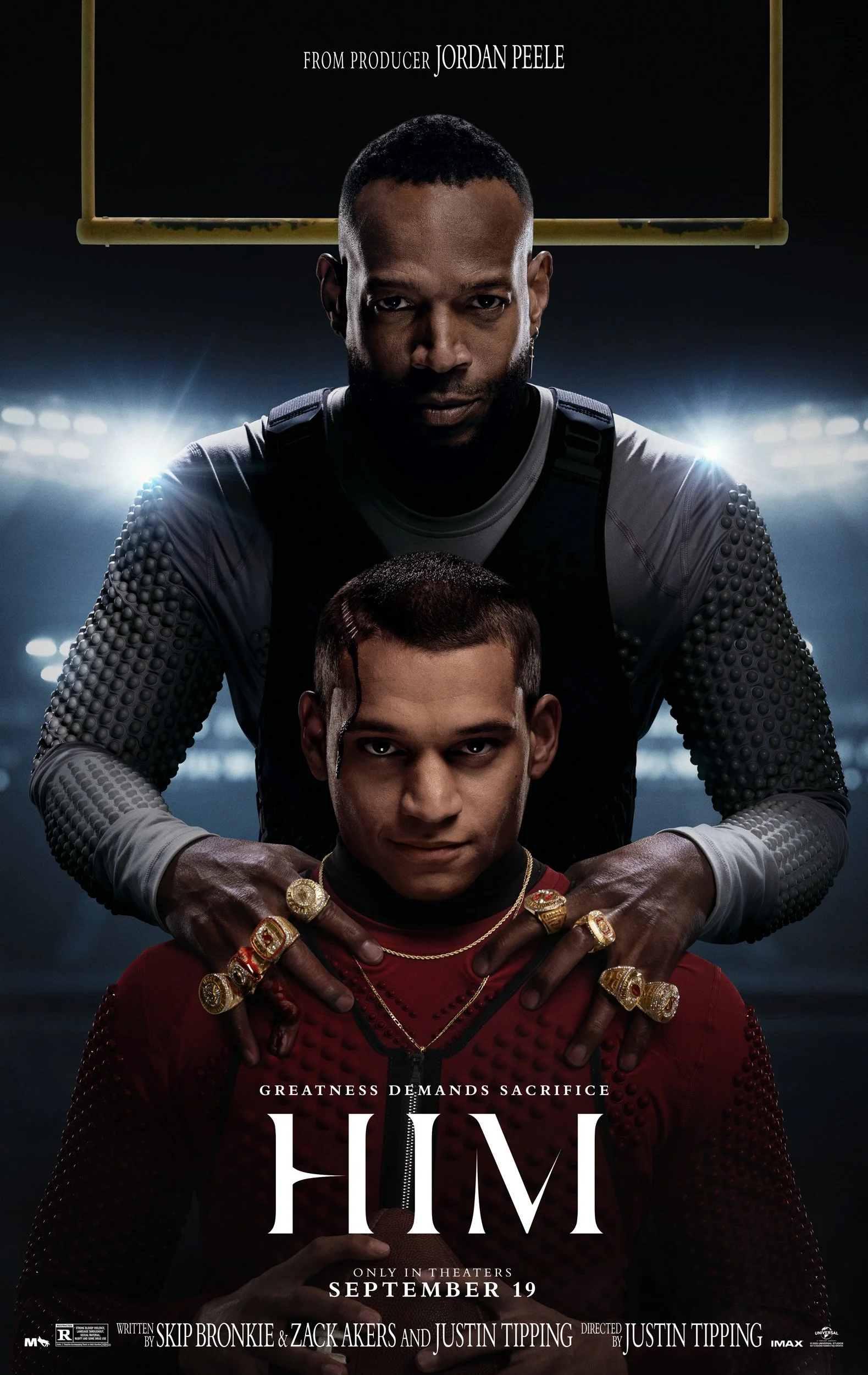
At first, the film catches your attention. We see a middle to low-middle-income family watching a football game together as the camera focuses on a young Cameron Cade (Tyriq Withers). As Cameron grows up, he aspires to be a professional football player so that he can fulfill his deceased father's dreams. When recruited by the NFL, Cam enters a private, intensive training camp with his coach, Isaiah White (Marlon Wayans). It's the setup for a typical slasher. Our protagonist enters an environment cut off from all outside communication, as the killer (in this case, the coach) has our lead trapped. The only difference in this film is that the protagonist doesn't want to escape their prison; they embrace it. That's a really cool angle that's never fully explored in favor of explicit gore, insulting the audience's intelligence.
Minutes into the film, you might be taken out. When a creepy person shows up with a murder weapon, causing Cam a traumatic head injury, it's clear the movie is going to enter slasher territory. Instead of making a smart film about the dangers of toxic masculinity, the costs of fame, and America's insistence on grooming and raising multicultural athletes, the screenwriters go for the most obvious metaphors imaginable.
95% of the movie is Cameron being screamed at by Isaiah. The mental and physical abuse athletes deal with is already ten times scarier than the amount of blood director Justin Tipping can throw at the screen. Tipping goes beyond the tipping point of idiocy by constantly reminding us how professional sports don't care about a player's physical or mental well-being. It's about winning. In case you didn't know that football stemmed from gladiatorial sports, the writers will remind you of that ad nauseam.
Him is so unsubtle in its approach to physical pain that it draws inspiration from Mortal Kombat games, featuring an X-ray vision of Cam's body getting injured. Specifically, his heavily stitched head, which doesn't further concuss him? Cam's head gets slammed more times than a baby who was dropped continually by neglectful parents. I'm no expert in head injuries, but it doesn't seem feasible that one would imagine a Danny DeVito look-alike dressed in football fan face paint harassing you. Is most of the film in Cameron's head? The answer to that question is thunderously stupid.
If there's a benefit to the film, it's in the performances. Mostly. Marlon Wayans plays a great unhinged psychopath loaded with testosterone. Wayans is legitimately intimidating even when he overacts. One notable talent who can surprisingly dramatically perform is comedian Jim Jefferies, playing Isaiah's doctor. Jefferies is restrained, clearly in psychological torment, but he can't show it. Of everyone, Jim Jefferies has the most nuanced performance. The main character of the picture, played by Tyriq Withers, is weak. The man shows no emotion other than rage and confusion. It doesn't matter if that's what the role asked for. Give the audience more. Withers has the emotional grace of a football, causing the film to fumble its themes.
Justin Tipping attempts to make a film about toxic masculinity, directed with the care and concentration of a roided-up dude. For a film about emotional immaturity, the film is emotionally immature in and of itself. That's unfortunate, as there's a lot of potential in the concept. You want to see how deep it goes until the end, when the picture goes off the deep end. What's supposed to be shocking is laughable.
The climax of the movie plays like a final boss fight in a video game, with the movie using a post-production process to make the walls look like they're shaking from smoke fumes to resemble hell. Here's an idea: why not try to get the fumes in camera like Raging Bull did? Why be so lazy? The last scene unintentionally resembles the ending of Robert Altman's The Player. It's the cinematic equivalent of Bruce Willis breaking into prison and saving Julia Roberts from public execution.
Everything the movie is building up to is thrown out the window for a forced happy ending that sticks it to the white man. It's obvious what the filmmakers are saying, but happy endings are not welcome with this type of picture. For such a great concept, the results are terribly conceived. The cleverness of Jordan Peele is missing. Him comes off as a cheap homage to Get Out and Us, feeling more like an R-rated Key & Peele sketch than a meaningful horror flick.