'Brunello: The Gracious Visionary' What's a Humanistic Capitalist?
Have you ever watched Undercover Boss and felt seething rage? You’re watching the episode, and you see someone who’s a millionaire, possibly a billionaire, throw on a fake wig, some facial hair, then dress up like a construction worker or cook. Suddenly, they have to do blue-collar work so they can see what it’s like to be in their worker’s shoes. By the end of the episode, they realize how greedy they’ve been and give their employee from the episode a few grand to get their life back on track. Anyone with a brain can tell that it’s a disgusting fabrication aimed to please the newtwork’s shareholder’s profits. This movie actually aspires to what that show’s propaganda tries to be.
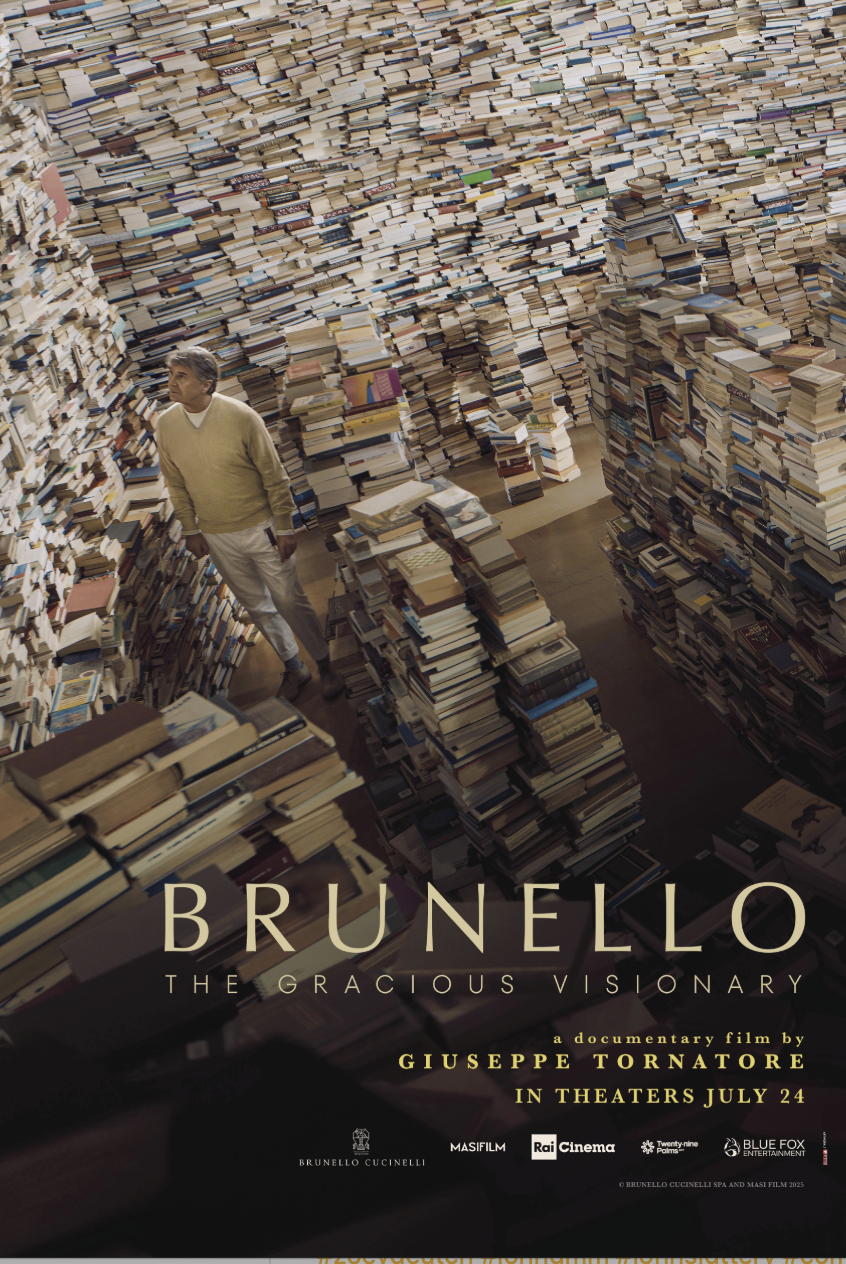
Brunello Cucinelli is not your typical CEO. He doesn’t carry around a fake smile or swagger. He’s not masking, just being genuine. Brunello’s story is a rags-to-riches tale that proves why it’s better to trust a CEO who came from nothing than a spoiled little nepo baby (cough, cough, Trump). There are nepo babies out there who have made the world a better place, like FDR and JFK, but it’s the evil ones who leave a turd in society’s punchbowl.
Brunello has the inherent value of kindness that seeps into this finely crafted picture. Director Giuseppe Tornatore makes a movie that’s a mixture of narrative filmmaking and documentary that blends seamlessly together. The picture’s opening moment starts with a long dolly shot of crops being burned at a farm that’s going under. The final shot of the film matches its frame but with a much more optimistic scene. Where most reenactments look like cheap History Channel moments in other docs, the reenactments here have the same aesthetic fidelity of an actual narrative film.
The movie’s style comes off like Cinema Paradiso. Well, that’s because it’s the same director. Giuseppe Tornatore has a knack for telling stories about people who come from Little Italy and make it big. He knows how to capture the community elements and the beauty of the country unlike any other director who points a lens at the picturesque locale can. No matter where you live on the map, Tornatore makes you feel like Italy is your home. Like George Lucas said once, “you’re not watching the podracers, you’re listening to the music.” Without a darn good score, this picture would incite no emotions. Nicola Piovani's haunting melody doesn’t elicit the typical whimsical notes occupied for movies about good guys, but rather something deeper. It’s a score that’s almost too good for a documentary, if the cinematic standards of documentaries haven’t increased since the normalization of 4K cameras.
Brunello claims to be a humanistic capitalist. Although he makes more money than is even imaginable by selling dyed cashmere sweaters, he doesn’t pocket all the profits for himself. He gives his workers a good living wage, serves them food he loves at the factories, and invites them to his land for dinner. His background as a card player hanging around in a local pub occupied entirely by men has given Brunello the advantage of reading what other people are feeling. Whether everything in this movie is genuine or we’re just viewing a vanity project is something the audience might wonder. But it feels more authentic than your typical Undercover Boss episode.
Some moments will make you squirm, such as when Brunello decides to depict himself as Christ during a staged crucifixion. It doesn’t matter what his point is; anyone who depicts themselves as Jesus has an inflated ego. There’s also a huge birthday party our protagonist throws for himself. It might be a personal thing, but I always felt people who throw their own birthday parties are narcissistic. Although the movie tries to make Brunello Cucinelli look like a perfect person, these two instances might hide a slightly dark side to Brunello that perhaps the director doesn’t want to show. Granted, nobody’s perfect, so why make your subject look like a saint? There’s also the issue with subtitles.
Foreign language movies need to stop committing this cardinal sin. If your subtitle is white, it doesn’t matter if you add a black drop shadow; white titles set against a white background are unreadable. Make it yellow or add a black border behind it. I feel like I missed half the movie because I couldn’t read what anyone was saying. I saw the movie on a 1080p TV, then switched to a 4K laptop. On the 4K, it was more readable, but just barely, so clearly, it’s not a matter of format. Granted, if you see it on the big screen, it’ll be easier to read. Plus, this is a documentary designed to be seen on a big screen. Not a MacBook Pro screen. But what happens when you can’t rewind the film in the theater to catch what someone said? At least it’s not as bad as an untitled sound mix from a Christopher Nolan film.
We need movies that exemplify more optimism. Brunello Cucinelli proves that there is hope in humanity. Not everyone who comes from nothing to being everything walks around mocking those who struggle, saying they don’t work hard enough. Some people surround themself with literature. It’s those who are educated and have knowledge who are usually the most compassionate. The movie could have benefitted from having more interviews with factory workers and family members instead of celebrities like Oprah Winfrey and Patrick Dempsy who could have been cut entirely from the film. As a piece about the good in people that isn’t a pure work of fiction, Brunello is a beautiful movie to visit.