'Disclosure Day' Discloses More Than Just Aliens
If not for the President releasing the alien files to cover up the other files, Disclosure Day would have had a greater impact. The day we found out that aliens existed, the world was met with a resounding “meh.” Still, as a piece of filmmaking, Disclosure Day is an impressive feat of old Hollywood storytelling that we don’t get often today. Contrary to Close Encounters or War of the Worlds, Disclosure Day is more about pacing than it is about visuals. As a thriller, Disclosure Day is brisk and relentless. As a meaningful piece on coexistence, it's good but not up to par with Steve's best work.
One thing you have to give the GOAT of popular filmmakers is his eye for visuals. The opening shot of the movie looks like a mix of Saving Private Ryan and The Wrestler, while also breaking the 4th wall. We then cut to a more casual visual method. Except this isn't just some guy who shoots with meaningless coverage; every shot is unique and presents itself to the audience only when the time is right. From the start, the movie hits the ground running. Our protagonist is on the run; he has something very valuable. We don't know what it is until what feels like thirty minutes into the movie.
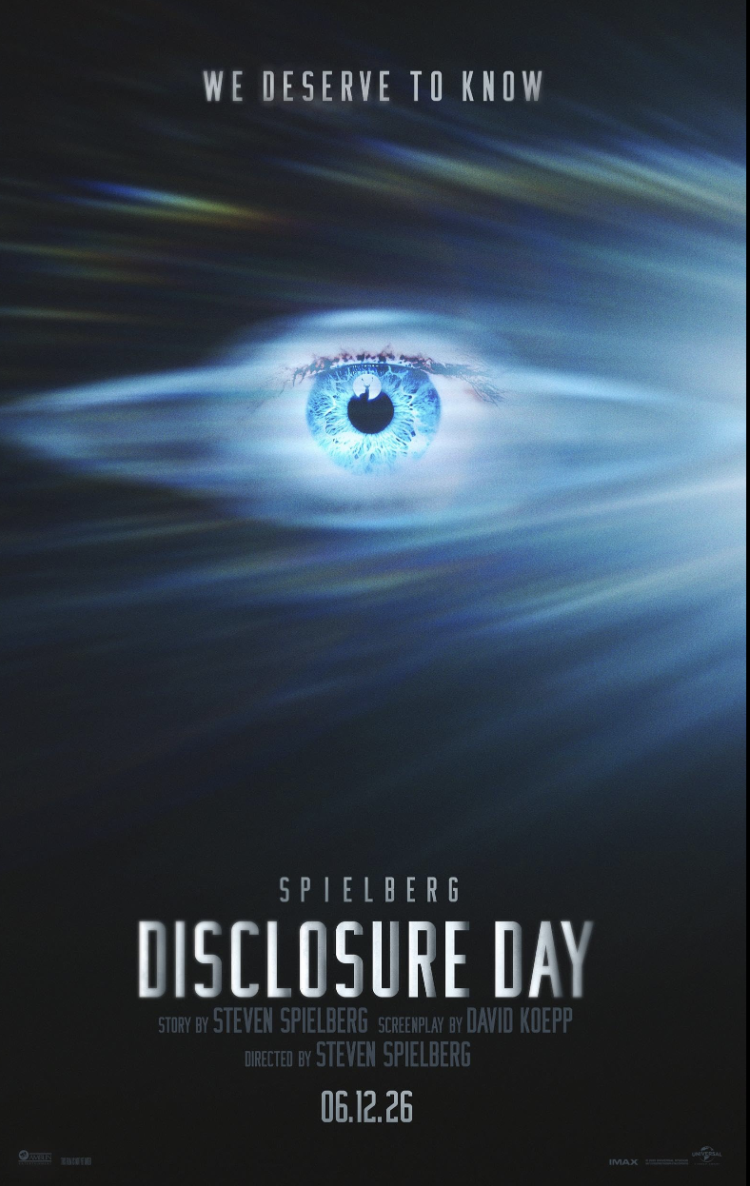
Disclosure Day is a mystery that, on its own premise, spoils the film's first few minutes. With Spielberg's name plastered all over the place on every poster, it's not hard for anyone familiar with Steven Spielberg to figure out what is going to be disclosed. The film also hinders a relationship between Daniel Kellner (Josh O'Connor) and Jane Blankenship (Eve Hewson). It seems to build to something, yet feels a bit forgotten. However, there's something genuine in the acting between the two, although it lands a bit flat at the picture's grand finale.
The real knockout performance of the film is Emily Blunt. Her character, Margaret Fairchild, is one of those stereotypical sexy weather ladies the local news casts. Margaret is more than just good looks, however. She has the integrity of a real journalist. Her boss sees that, yet still reprimands her when arriving late to work, threatening to take away her anchor spot. If you've seen the movie's trailer, then you know what happens to Margaret once she goes on the air. Soon, Margaret is breaking into an unknown, guttural, clicky language. At several points in the picture, Emily Blunt seamlessly delivers long stretches of dialogue in multiple languages. That must have taken a lot of training. Plus, Blunt pulls off a grand American accent, while the Americans look foolish ninety percent of the time when they try to do an English accent in other pictures. It would be an easy early call for Emily Blunt to be nominated for Best Actress.
How can I not mention John Williams' score? Even at 94, Williams can compose something beautiful. The score doesn't feature any memorable pieces you'll be humming after the credits roll, but it has an orchestral quality that most modern films lack. Not in terms of instrumentation. But driving emotion. Most scores are unrecognizable, bland crescendos. While Williams drives for the heart. It's not among his best. In fact, it sounds like anything you could play on a greatest hits album. However, those soft choral beats still reach a part of the soul.
Many criticize Spielberg for being overly sentimental. What those critics don't seem to realize is that Spielberg is a child at heart yet an adult in mind. His films can be soft, but they're also smart. Long-time collaborating screenwriter David Koepp pens a story about more than just kindness, but religion. We always believe in the concept of God looking over all of us. But what does all of us really mean? We like to think it's about all people on earth. But what if there is life outside of the Milky Way galaxy? What about all of those beings? Do they share the kingdom of heaven with us? Not only does Koepp's screenplay question our understanding of a deity, but also the importance of journalism.
The government is trying to cover up the thumb drives containing all the alien videos. But why? Why are they afraid the world will collapse if we find out we're not alone? Maybe it's because they're trying to hide something beyond the knowledge of extraterrestrial existence. Although Disclosure Day couldn't have come out at a worse time, since we're literally living in tragic comedy, it also couldn't have come out at a better time. Although we've already had our disclosure moments, we're also losing our media to misinformation running rampant and unmonitored on social media, while CBS is collapsing. We need independent journalists with the bravery to put their freedom on the line to disclose what's really happening behind the scenes from the most powerful people in charge of the world. Otherwise, we'll collapse among ourselves. Without bravery, there's no unity.
During the movie's emotional payoff, it lands moderately well. The problem is that Spielberg has already made this movie many times before to greater effect. Steven Spielberg is a victim of his own greatness. Yet there's no denying that, even at his age, Spielberg can show everyone else how to make a movie. We don't get thrillers like this anymore. More so, there aren't a lot of alien movies with this much thought attached to them. If you're looking for a Spielberg movie to have the intellectual depth of an Andrei Tarkovsky or Jean-Luc Godard film, then the closest thing you're ever going to get to that is Munich.
What those filmmakers lack, which Spielberg has, is, in fact, sentimentality. He's sentimental, yet never talks down to his audience. His movies are the perfect blend of everything that reaches the public in ways other filmmakers struggle to achieve. Although Disclosure Day may not go down as one of Spielberg's best films, it's still a wonderful crowd-pleaser whose hits far outweigh its misses.