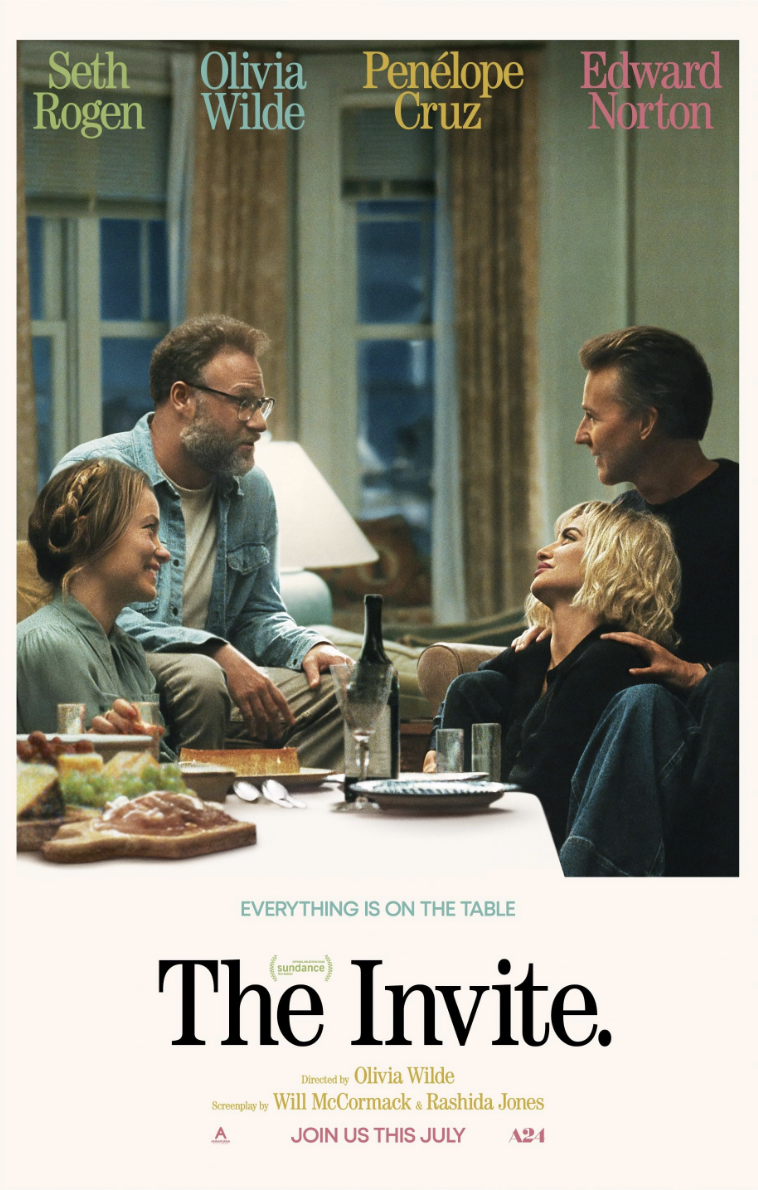
'The Invite' is a Funny Stage Play Done Right
The Invite is an actor’s play that works remarkably well as a movie. It should be no surprise that this movie is adapted from a play, since it all takes place in a single small apartment. The movie succeeds in maintaining the audience’s engagement as the screenplay continually ups the ante with increasingly absurd situations. It plays its comedy at a breakneck, dialogue-driven pace, like an Aaron Sorkin screenplay if it were full of sex jokes. Although starring Seth Rogan, The Invite isn’t entirely a comedy. It doesn’t look like one, and certainly doesn’t end like one. But it earns consistent laughs for its running time.
The Invite has the elements of many predictable comedies, yet it decides to land itself in a more ominous direction. Although throughout most of the movie you’ll feel pretty good, laughing along at each awkward moment after the next, it’s the final few moments where you may realize that this isn’t just some other crazy situation movie. It doesn’t end with everyone learning how to be happier or more interconnected; rather, it leaves them feeling miserable, wishing they hadn’t made the decisions they did throughout most of the picture. Some of the best movies are the ones that leave room for an interpretive ending. It’s up to the viewer to become a storyteller rather than just merely a consumer. Will things work out in the end, or won’t they? Most films would give you a bit of hope. The Invite devilishly yanks the rug out from under the audience.
The story is your typical setup. Joe (Seth Rogan) comes back to his New York City apartment after work. He’s tired, and his back hurts from riding on his bike. Without his permission, his wife, Angela (Olivia Wilde), invites her neighbors over for dinner. Joe doesn’t like the neighbors since they have sex loudly in the middle of the night. Very reluctantly, Joe agrees to help host the strangers in their home. Once the two arrive, the movie turns into a situational dramady. If you thought the neighbors were just having loud sex in the middle of the night, there’s a whole other kinky angle behind the midnight bangings. Yet the late-night sex isn’t just treated like a punchline. As the story progresses, we learn how the flame in Joe and Angela’s relationship has sizzled out. What used to be nights of wild, passionate love has been replaced by a year-long drought of blue balls.
A relationship begins to truly develop when the sex starts to go away. Once you casually see your partner take a morning dump with the door wide open, it’s time to start working on tolerating each other's little quirks. If you can, then you’ve won the marriage game. Many can’t. The slightest inconvenience becomes nails on a chalkboard because you’re spending every minute with this person and just want them to go away for a little while. Angela does the typical stuff an annoying partner would do, such as mingling with people who don’t need mingling. If the neighbors are sounding like something from National Geographic at 3 in the morning, the last thing I’d want to do is be friends with them. The movie makes you question who’s in the right. Is Joe being antisocial, or is Angela too concerned with fitting into a wider social circle, unable to comprehend that not everyone has to like her?
When we learn of Pina (Penélope Cruz) and Hawk’s (Edward Norton) personal issues, they seem to go from being the oddballs to the folks who might have their screws together more than Joe and Angela do. Being odd allows one to be freer and more connected to the world. The activities Hawk and Pina engage in are certainly unconventional, but it keeps a passion alive that most couples don’t have. So who are we to judge them for being weird? Perhaps it’s conventional couples that have it wrong all along.
Amid the inner workings of a crumbling relationship, one element that’s oddly missing in the film is the child Joe and Angela keep referring to. Angela tells Joe that their kid adores him, but where’s the kid? If the two have a child, why are they treated like an afterthought within the film? What’s with these movies that have kids we barely see on screen?
Aside from that small issue, there’s hardly a stageplay nor comedy like The Invite. It challenges traditional family and attraction values, making you question whether you’re really in love with the person you’re with. And what happens when we forget to be thankful for what we have? When we’re kids, we’re full of joy, but as adults, that happiness gets bogged down by knowledge and responsibilities. Shot on 35mm film, the movie carries the spirit of a 70s New Hollywood-era flick, with images being a little dirtier and an ending message that may not be the typical Hollywood bed of roses. But if you stick with it, you’ll get something much more meaningful and hilarious than your typical sentimental, feel-good slop.