'The Death of Robin Hood' Finally Hits The Target
If you fail, try, try again. Or in this case, attempting the same thing for the fifth time? I don’t know exactly how many Robin Hood reboots there are, because it doesn’t matter. To the studio’s luck, the only Robin Hood I’ve ever seen was Mel Brooks’ Robin Hood: Men in Tights. So, taking the character seriously as a gritty figure was a tough sell all those other times around. As a film on its own, it’s interesting yet drawn out. There are wide attempts to reach a grand thesis, yet some of its ideas don’t hit the mark. As an idea, The Death of Robin Hood is profound. Yet it overstays its welcome like an overlong funeral on a stormy night.
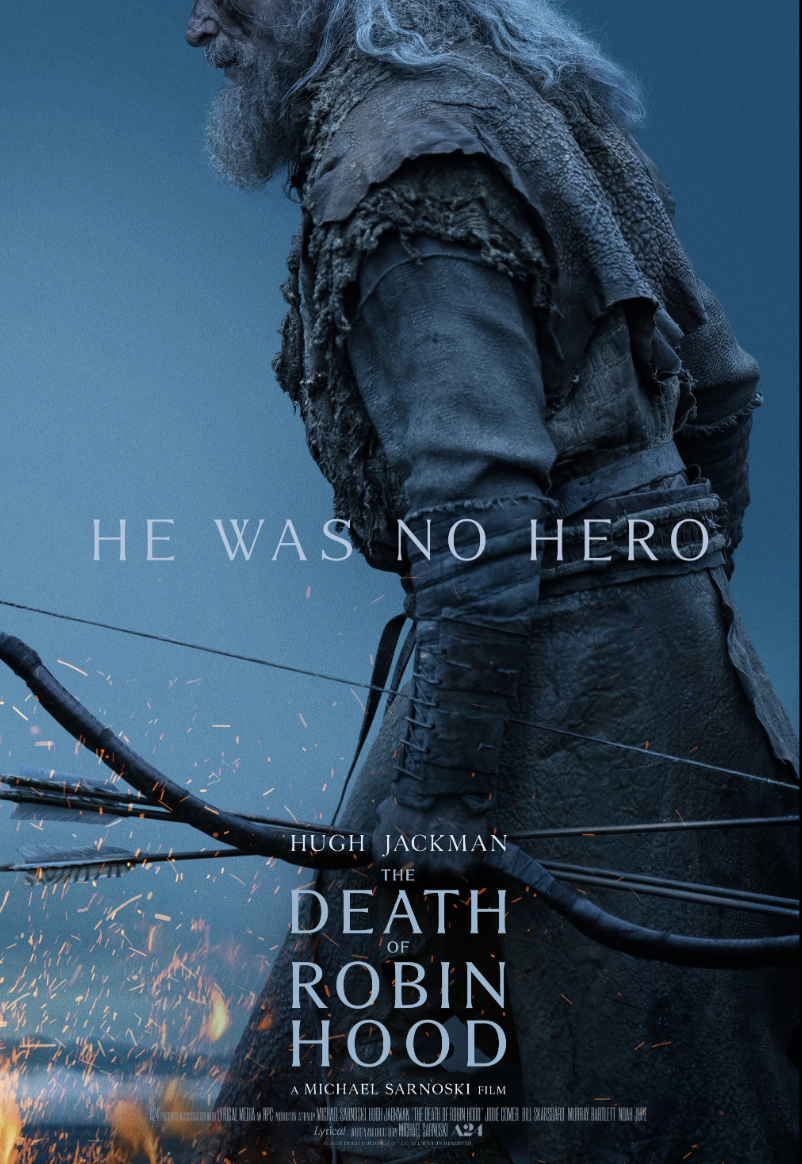
The picture opens in 1247, the final year of Robin Hood’s life. We’re given a grand monologue that’s completely ruined if you saw the trailer. By the way, feel free to check out the trailer above if you’re curious about the film. An old Robin Hood (Hugh Jackman) discloses that the stories about him aren’t true. Despite folklore, he’s a monster. Whatever happened to the love of his life, or any resemblence of humanity, is gone. It’s the selling point of the picture delivered to perfection by a marvelous actor. We’re drawn into the scene, wondering where we’ll go from there. As the picture draws out, it’s reliant on Jackman’s words; instead of spectacle to deliver the character’s backstory.
Director Michael Sarnoski is trying to make something scaled back, but it needs a flashback to show how Robin Hood, the man who stole from the rich and gave to the poor, became the shell of a man he is by the time we meet him in this film. At what point did he turn? Was he always terrible? If so, what did he do? Robin Hood discloses later on in the picture the unspeakable things he’s done, but it feels like that scene could have come in thirty minutes earlier in the picture.
One could argue that the movie is titled The Death of Robin Hood, not The Life of Robin Hood. But we need to see how that life led to that death to some extent. Call it my wanting to see Darth Vader kill everyone, or Homelander scorching the earth moment, but there needs to be some delivery within the premise. Don’t just talk about killing innocent people. Show Robin Hood arching bystanders, so we really feel the impact of his evil. Or give us a reason why he did what he did. And to whom. We get that to some extent, but in the form of what might be a hallucination from a dying Hugh Jackman.
Most of the movie is us watching a man wabble around on a cane or lying in bed. The prophecy of his regrets doesn’t yield any real revelations, as he still shows he’s a bastard. In one of the most traumatizing moments for a child to behold put on celluloid, Little Margaret (Faith Delaney) witnesses a double tragedy within seconds. Such an event would turn anyone into something very sick when they become an adult. Instead of comforting the child, Robin Hood instills fear in her, shaping her into another demon. The relationship between the two is incredible and sells the movie. This is what The Last of Us Part II was striving for but couldn’t deliver on. But like that game (and series), it doesn’t know when to cut itself short. With thirty minutes trimmed, The Death of Robin Hood could be a powerful film. From the mostly naturally lit 35mm cinematography to the stupendous score, layered script, and incredible cast, The Death of Robin Hood comes close to achieving greatness. If only the length didn’t limit the picture’s potential.
The movie shows that some people are unable to change. Robin Hood’s mistreatment of Young Margaret echoes his relationship with Edward (Bill Skarsgård). It’s a long delivery that pays off, but the lead-up should be stronger. When the movie, alas, delivers on the title’s premise, I left feeling less sad than the scene intended me to. Yet what happens with young Margaret is brilliant.
Robin Hood forms a friendship with Sister Bridget (Jodie Comer), only to be reminded that some men are beyond God’s grace. Guilt and regret are not enough. Some men must seek penance to achieve any form of redemption. Robin Hood is not interested in penance. Always looking for an easy way out, never learning from his mistakes. Robin’s death wasn’t painful enough for the things he’s done. So, not exactly the Disney version of Robin Hood. Although deep, the movie feels almost like it could put you to sleep with all of its scenes of Robin napping off. See the movie for Robin Hood, stay for what he does to Margaret.