'The Wizard of the Kremlin' Doesn't Carry The Kremlin's Strength
Let’s address the elephant in the room. The accents in this movie are atrocious. No, not Jude Law’s accent. He was doing what the director asked him to do. But Paul Dano, what are you doing, man? As a defender of his performances, it’s painful to say that maybe Quentin Tarantino was right about him, at least for this one instance. The Wizard of the Kremlin is one of those Hollywood movies where a bunch of actors use British accents to make up for the fact that a movie with a Russian-speaking cast wouldn’t be marketable. You need stars to sell your picture. Unfortunately, stars can also sink the ship like it’s the Kurks (K-141).
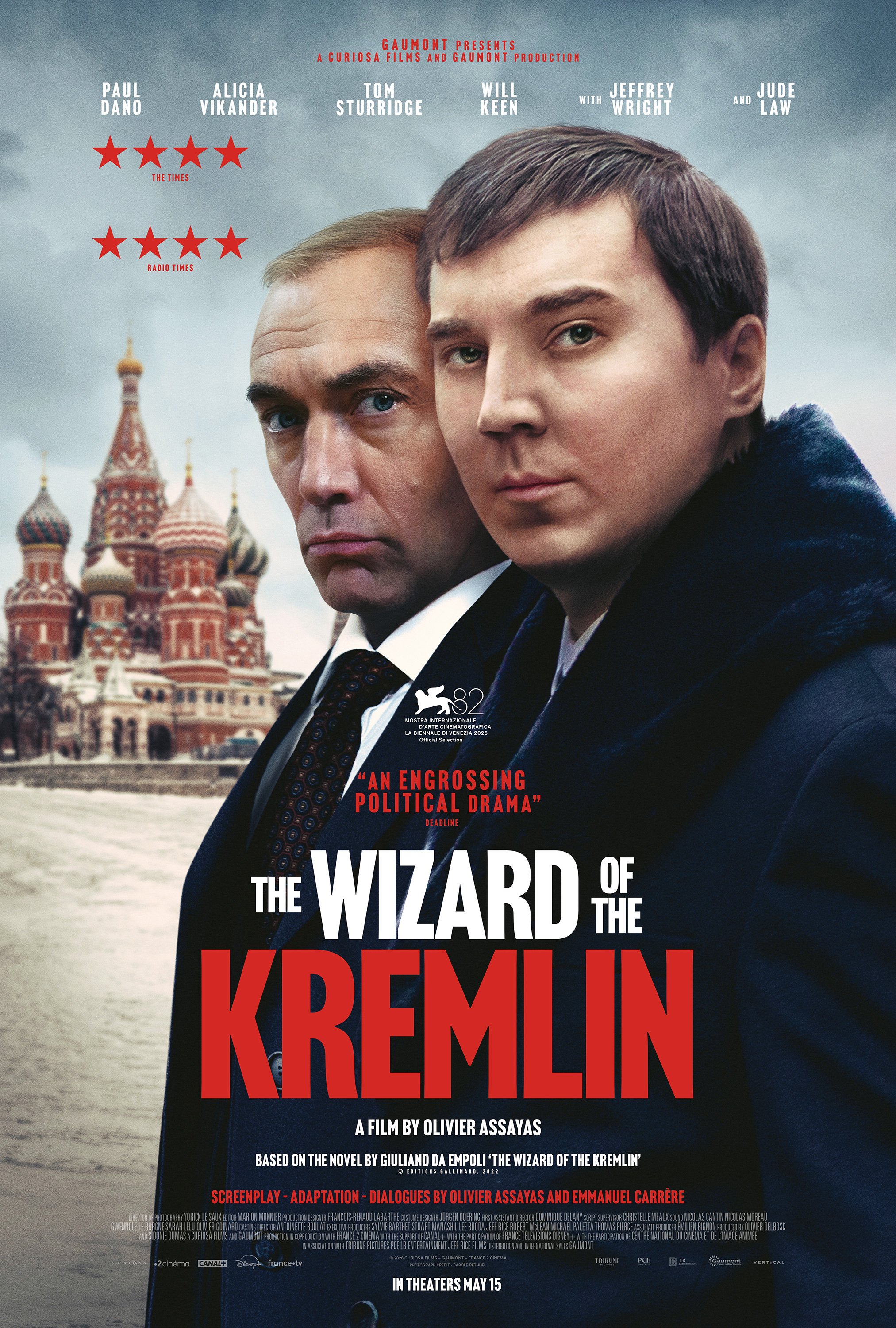
It’s not the actor’s fault, except for Paul Dano. Everyone is meant to sound English because American accents are possibly the clumsiest, most inarticulate accents out there. It’s easier to buy Jude Law as Vladimir than Paul Dano with an accent that’s about as bad as Kevin Costner’s from Robin Hood. Even though Jude Law sounds like Jude Law, he does the best he can to emulate Vladimir Putin’s face and mannerisms. He has the stiff half-assed handshake, the stern face that always looks disgusted; if the man didn’t speak, it would have been a great silent rendition of VP. But then Director Olivier Assayas decides to tell Jude to just sound like himself, then tells Paul to sound more British, destroying the audience’s suspension of disbelief. Instead of being engrossed in a political drama about the rise of fascism, we’re instead distracted by the Director’s cheesy tricks.
There’s a lot of potential in The Wizard of the Kremlin that goes unchecked due to poor directorial decisions, not only in performance, but also in story. The picture doesn’t know which lane to choose when telling a narrative. Is it about a man who compromises his own morality in favor of opportunism? What would that do to a person’s conscience? Hardly is the protagonist’s consciousness explored. It’s more about how he helped Vladimir Vladimirovich Putin rise to power. After Boris Yeltsin had to retire due to his ailing health, Putin took his place, bringing Russia back to the state of fear it lived under Joseph Stalin. Putin, in the film, even states that he wants the people to live in terror as they did with Stalin, so that he can rule with an iron fist. Putin’s power mirrors the rise of any dictator. From Stalin to Mussolini to Hitler, all men play by the same playbook. What the movie is saying about Putin’s ability to manipulate his people is far more interesting than whatever Vadim Baranov (Paul Dano) is doing, because despite some disagreements that Baranov had with Putin, he hardly wavered from his ego.
It’s not until an abrupt end to a bloated movie that we get the sense that any of Vadim’s actions weigh on him. Probably because he’s a heartless bastard who, like most people when they discover power, becomes an all-encompassing vessel of selfishness. If you’re going to make a movie about a terrible person, then you need to find something relatable in that character. Take Daniel Plainview from There Will Be Blood, for instance. Planeview is the epitome of greed and evil. However, the audience knows he loves his son, but neglects him because he values money over human connection. We know that he ran away from home at a young age, and if perhaps his life was a little different, he wouldn’t have become the cruel oil man that he is. The movie doesn’t dive deep into Planeview’s weepy past. We get only a few lines of dialogue that reveal his background, but it’s more than enough. With Paul Dano’s character in this film, we get nothing that explains why he’s the opportunist he is, leaving the audience apathetic towards him.
The film chronicles the life of a fictional character who becomes the man who helps orchestrate Vladimir Putin’s public image. The concept of the shadowy right-hand man has been done various times. Often, it’s a crutch filmmakers use when they don’t know how to make an entire movie about a notorious figure. The Wizard of the Kremlin is one of those typical Hollywood biopics that do little to elevate their narratives.
The most interesting parts of the story are a side note in a very long film that tries to cover decades of material, when perhaps it could have focused on one or two historical instances instead of half a history book. There are clear allegories drawn to the most ubiquitous dictator living now, especially when the story gets into how Russia is controlling the flow of information across the internet. So why not get more into that? We know what the writers are going for and why this movie is being marketed. So why not examine Putin’s influence on Orange Hitler? The movie is so bloated that it feels like you’re reading a long, boring history lesson assigned for class rather than engaging in a drama. Since this movie is a total Hollywood fabrication masquerading as a true story, there are so many missed opportunities, poor pacing, and laughable performances that make The Wizard of the Kremlin a forgettable viewing experience that Putin wouldn’t even bat an eye at.