'I Swear' Will Make You Tick with Joy
For as long as Tourette’s has been around, we’ve rarely seen a film that properly examines it. It’s mostly something that’s used as a punchline in movies. It’s understandable as to why. Someone uncontrollably blurting out the most offensive thing possible is hilarious. What isn’t so funny is living with a condition that limits the activities you can do. You can’t go to the theater, church, or library, because your ticks will ruin everyone’s time. Let alone attend an awards show where uneducated folks like Jamie Fox chooses to insult rather than self-educate. Writer/Director Kirk Jones might be one of the first filmmakers to take a serious dive at what it’s like to live with Tourette’s Syndrome. What he makes is nothing short of a beautiful portrait of the powerful impact that human kindness can bring to make one’s life worth living.
The story of John Davidson has been well documented by the BBC since 1988 in a doc called John’s Not Mad. For anyone who thought Davidson’s tick at the BAFTAs was intentional, watch the documentaries about John on YouTube to inform yourself. We’ve seen how John’s life has negatively affected him, but we’ve never seen it in narrative form. In I Swear, the audience is given a serious yet humorous look at John’s condition. Kirk Jones knows to give the material some levity because let’s face it, as tragic as Tourette's is, it’s also really funny.
In the picture's opening moments, Jones establishes the tone as a nervous John (Robert Aramayo) accepts an honorary medal from the Queen of England. It makes sense why John doesn’t want to go in as he immediately blurts out “F the Queen” within her presence. As bad as it is having Tourette's, only John Davidson can say he told the Queen to F off, then received a medal from her minutes later. Once the mood is established, the picture slowly begins to take shape.
John didn’t have Tourette's from birth. It’s something that just crept up on him as he entered his early teenage years. John’s ticks prevent him from pursuing a future in soccer (which he was thriving in before the ticks came) and create distance between him and his parents. During the 80s, people didn’t know much about Tourette's. Heck, the BAFTAs proved that folks still don’t understand Tourette's. Imagine how bad it was over forty years ago. John’s parents can’t understand why he uncontrollably swears, twitches, or spits his food out.
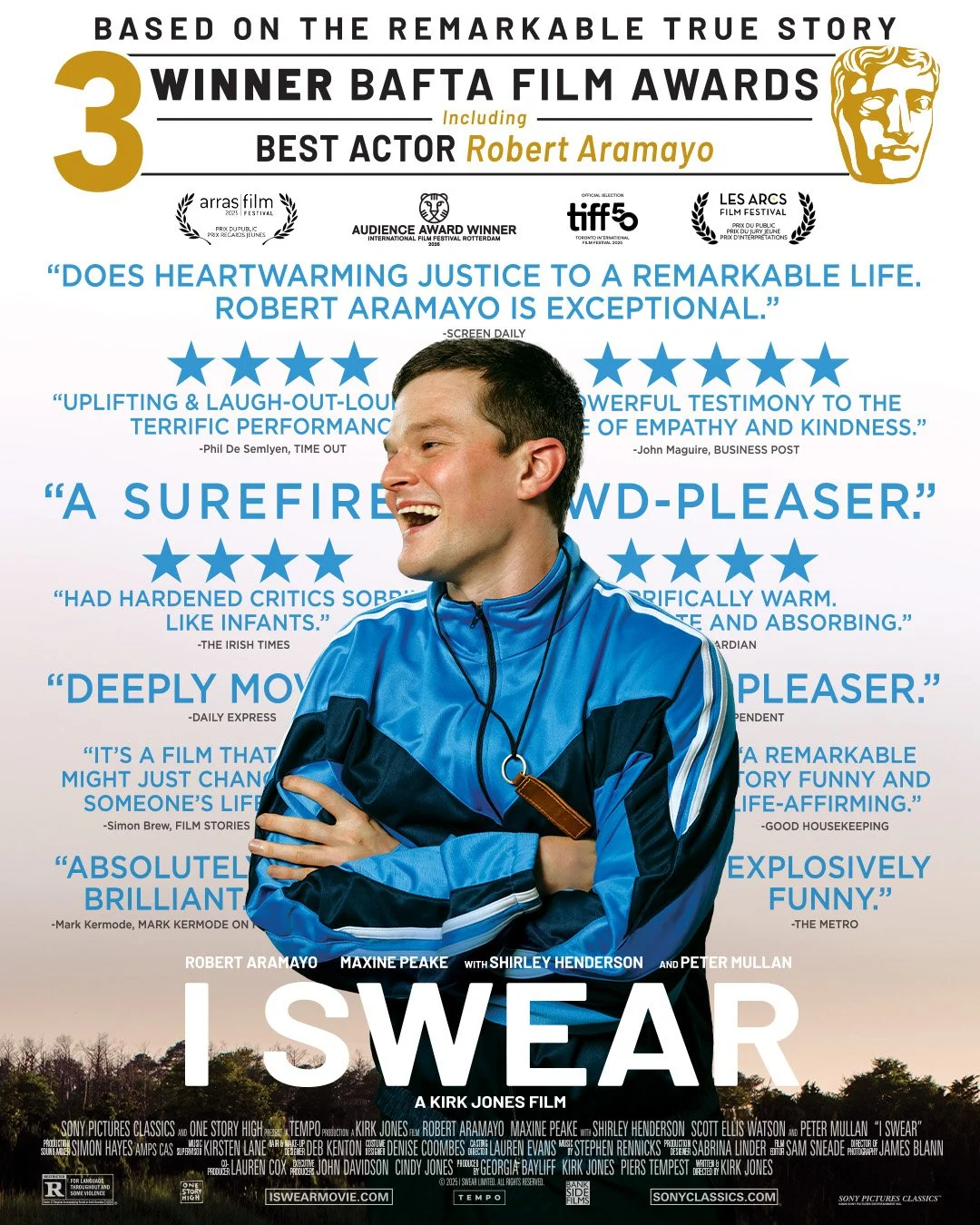
Luckily, Johnny finds his miracle worker. Dottie Achenbach (Maxine Peake) is a mental health professional and one of John’s friends’ mothers. She’s dying of cancer and wants to help another person have the best life possible despite their condition before she passes. Dottie contains the type of empathy that John’s parents lack. If not for Dottie, John could have been institutionalized for years. The movie is at its purest when we see the people who help John lead a productive life. Not just from Dottie, but also Tommy Trotter (Peter Mullan). The two help John gain confidence, enabling him to seek independence. The chemistry between the whole cast works beautifully, with the standout being the star of the show.
Playing a character with a disability (though Tourette's is often miscategorized as one) is a cheeky way to win an award. When it’s done properly, however, one can’t ignore the performance. Robert Aramayo gets all the ticks and screams down just right where he’s playing a character instead of a caricature (cough, cough, Ray). As someone who’s seen multiple documentaries on John Davidson, it’s amazing how much Aramayo not only has the physical mannerisms of John down, but the voice as well. He’s not doing an SNL impression of the man he’s playing. Robert sounds like himself yet transforms into John Davidson without resorting to extreme method acting. Or at least it seems that way.
Some critics may complain that this movie is too sentimental. I can’t agree with that. There are certainly the overly mushy pictures that come out each year from big studios, but the sentiment in this flick feels genuine. There aren’t scenes where John is hoisted on Tommy’s shoulders or an ending freeze frame of John smiling. The picture is more about the power of community. One group session with other people who have the same condition as you makes an enormous difference in one’s life. John goes from being misunderstood to opening other people’s hearts. The emotions feel real, sweet, and genuinely uplifting. Perhaps the film didn’t need to speed up and slow down again narratively. Also, for a film about Tourette’s, wouldn’t the filmmakers consider educating the audience about coprolalia? As someone who knows the basics of Tourette’s, I’d expect the picture to be a little more educational. Even so, Kirk Jones nails the emotional angle of the picture.
I Swear is one of the funniest, stirring movies coming out next week, that’s a crowd-pleaser without relying on emotional manipulation. The movie might be a tad cliché, but clichés exist for a reason. We all live on this planet together. With so many interconnected lives, we’ll inevitably be sharing the same experiences. Whether you have Tourette's or not, John’s struggles and triumphs are something anybody can relate to. Perhaps, if we had greater mental health awareness, we could be a more compassionate, happier society.
I Swear releases in theaters nationwide on April 24