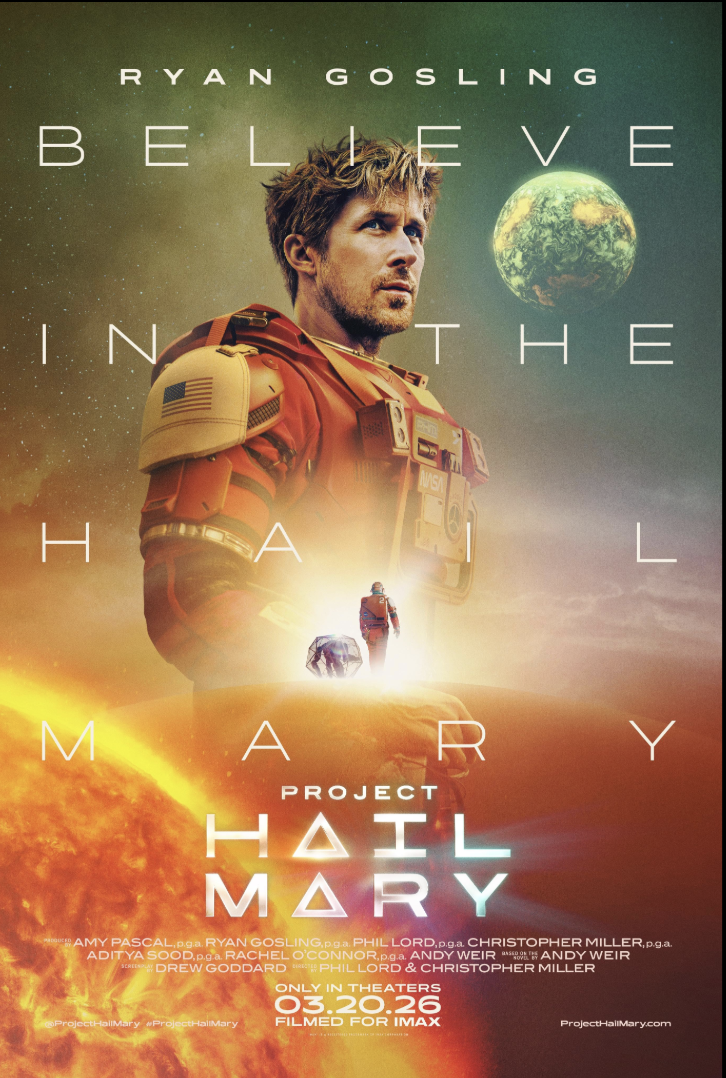
'Project Hail Mary' is Almost a Touchdown
Early buzz is spreading. Words like instant classic are being thrown around by fellow film critics. They may be right. This film is an absolute crowd-pleaser with incredible moments of visual splendor. There are instances when the picture brought a slight lump to my throat and a dazzle to my pupils. However, in between these high points, the film is weighed down by repetitive sequences that create stretches of monotony, especially in a visually impressive but lengthy montage that surpasses 2001: A Space Odyssey’s duration. This movie has great ambition and is the first time, since maybe ever, that someone has managed to replicate the spirit of ET and Close Encounters of the Third Kind without paying a dull homage. Yet, at 2 hours and 36 minutes, the movie could have been more profound by trimming its length.
Many folks would argue that a movie’s length doesn’t matter as long as it gets its point across, and that’s very true. This movie clearly hits its thematic strides and emotional cues. However, it sometimes undermines itself by unnecessarily repeating scenes and creating confusion through relentless rotation and quick cuts. While the science objective is clear, certain climactic moments lack explanation, making it hard for viewers to stay engaged. Given author Andy Weir’s other works, some plot elements become predictable, reducing suspense.
Much like Matt Damon, who’s perpetually marooned in space, our protagonist, Ryland Grace (Ryan Gosling), is stranded. The other astronauts didn’t survive the journey. Yet Ryland isn’t an astronaut. He’s a humble, endearing grade school science teacher poised for his hero’s journey. One day, the world’s top scientific minds uncover Grace’s theory that the sun is dying from a predatory energy parasite consuming its cells. Grace’s studies may hold the sole solution.
The picture works as two movies running at once. Half of the film is Grace in space, trying to figure out how to save the Earth. The other half is how Grace wound up on that spaceship, as he woke up with a mild case of amnesia. The movie isn’t structured like a flick where our hero pieces the puzzles back together, but rather how his memory recovers, yet he never really talks about it or has a moment of enlightenment from the past. It’s simply the natural (as natural as a Hollywood movie can be) progression of the recovering memory, acting as a B-track to the movie’s A-track, running alongside it.
The 'how we got here' segment could have been trimmed, as it’s clear early on how Ryland arrives at his situation. A major reveal late in the film could have been included earlier to reduce unnecessary buildup. The relationship between Grace and Eva Stratt (Sandra Hüller) attempts to add depth but ultimately serves more as a plot device than meaningful character development, weakening its emotional payoff. Overall, these structural choices dilute the film’s potential impact, despite efforts to build a human connection.
Project Hail Mary is an IMAX experience meant to be seen on the biggest canvas possible so you can feel like you’re in space. Yet all that scope doesn’t amount to didly squat without a very distinct relationship that must work, or the film would be doomed. Luckily, that kinship is a thing of beauty. Grace makes contact with an extraterrestrial whose bond takes up the picture’s majority. For most of the movie, Ryan Gosling has to act alongside a CGI character. Thankfully, this ET's design is different enough to feel unique. Rocky (James Ortiz) and Grace must learn to communicate to save the planet together. This isn’t a movie about an alien phoning home (mostly) or a man going back to his; it’s a story about two species coming together to save lives. The trials the two go through to achieve salvation for the Milky Way galaxy are a profoundly moving interstellar relationship that hasn’t been this resonant since ET touched Elliot’s heart.
Project Hail Mary might be the best space film since Interstellar. However, pacing problems prevent it from reaching its full potential. Despite moments of brilliance, the film’s bloated structure blunts its most powerful scenes. The message of building relationships for a common cause remains effective, but the narrative’s excesses and repetitive beats overshadow the film’s strengths. In a time of division, directors Phil Lord and Christopher Miller urge unity. Project Hail Mary succeeds where it matters most, showcasing impressive visuals and stirring music. While it may be classic to everyone but me, PHM’s ambition merits recognition.