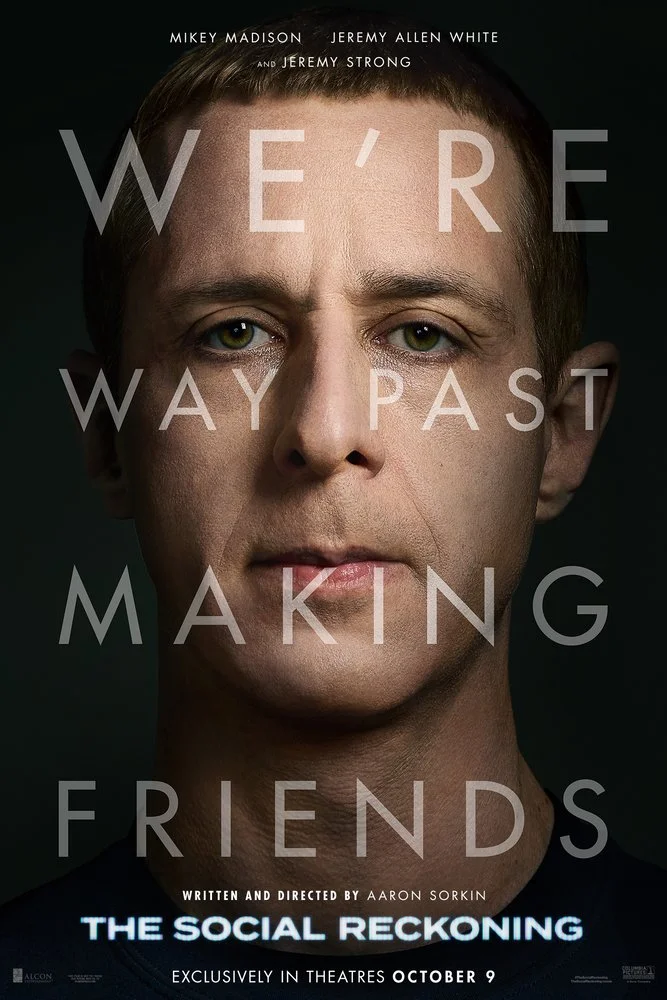
'The Social Reckoning' Fails to Drive its Content Home
It’s an all-star team with only one star still there. A sequel to one of the greatest films of this century isn’t necessarily a good idea. One would have to have a good reason to make one. Fortunately, Mark Zuckerberg setting the world on fire, possibly leading to our extinction, is plenty of reason to revisit David Fincher’s original masterpiece. With the stakes raised, writer Aaron Sorkin fails to deliver in the director’s chair. The message of The Social Reckoning is urgent, but its delivery feels like a Hallmark movie. This isn’t just a poor sequel, but a soapbox-standing flick that will do little to ignite a social revolution.
From the first frame, everything feels off. Instead of Trent Reznor’s fast-paced techno beats, the picture opens with a slow horn that sounds like it should be in A Few Good Men. Sorkin tries to establish the tone through those small cues that this movie isn’t going to be the first film. It’s going to be something much slower. What Sorkin fails to realize is that speed is what made the first film so great. A lot happens in the first few seconds of its opening that sucks the audience in. Here, we’re introduced to an exposé that’s not only deliberately slower-paced, but also lacking the dialogue of the first picture.
The first scene opens with an odd sequence that hammers home its point: social media drives misinformation. But it’s handled with a scene that’s laughable. This is how we’re going to communicate the algorithm crisis? By watching some drunk white girl mouth off? Later we find out why the movie starts with that character, but the reveal is too Hollywood, which is the problem with the entire movie. It’s more of an old-school Hollywood drama than something that’s meant to jolt the audience awake. Instead of being moved by Sorkin’s words of revolution, the audience was rolling their eyes at how ham-fisted it was.
One of the biggest strengths and flaws in this movie is the characterization of Mark Zuckerberg. Zuckerberg (portrayed by Jesse Eisenberg) was a jerk, but he wasn’t evil. The Zuckerberg (portrayed by Jeremy Strong) is a villain. Any sense of dimensionality to him is replaced by a stiff caricature of Facebook’s CEO. Jeremy Strong’s performance is totally different than Jesse Eisenberg. He’s even crueler than before, sitting in a posture that makes him look like a robot with a stick up its rectum. It’s much closer to the real Zuckerberg than what Eisenberg portrayed. Whenever Strong is on the screen, his presence is absorbing. Yet his characterization is limited to make room for the two new, boring protagonists.
The Social Reckoning is a journalistic piece. Wall Street Journal reporter Jeff Horwitz (Jeremy Allen White) investigates a trend in Facebook algorithms that traces back to a spike in traffic from anger-driven content. To help him find out whether Facebook is aware of this dangerous trend, he’s sought out by one of Facebook’s engineers, Francis Haugen (Mikey Madison), who blows the whistle on Facebook’s malicious data.
The characters lack chemistry because they lack any real, discernible characterization. The most we know about the two is what they say repeatedly to the audience. Jeff is technically deficient. He doesn’t have a Facebook account, and he doesn’t spend all his time glued to his phone like the rest of the population. Frances loves her job at Facebook. We know because she tells the audience every two seconds that she loves Facebook. But she’s disturbed by them dropping their civic integrity protocols. What started as a site for making friends and sharing experiences has been diluted into a toxic platform that has driven America into the nightmarish place it is today. We already know this, so why should we care about these characters beyond their mission?
Jeremy Allen White and Mikey Madison's performances aren’t particularly dynamic. Both speak in a tired, monotone voice. It’s not entirely their fault. Sorkin’s middling script is probably some of his weakest work. The movie seems almost like it was broken down on a napkin. Its structure is unexciting. It jumps back and forth through time with chapter breaks and a visual timeline indicator that’s a lazy cheat. There’s some clever humor, as that’s all the script really has going for it. We’re not getting invested in the plot’s Metaness because it’s so bogged down by its heavy-handed message. Sorkin forgets that it’s the characters that made the first film so thrilling in the first place. Not the plot. When the picture reaches its clumsy political reveal, folks on both ends of the political spectrum will disengage from the movie’s Hollywood delivery.
Without David Fincher, Jesse Eisenberg, Trent Reznor, and Atticus Ross gone, the audience gets a poorly paced, poorly edited, decently acted picture. You know your movie is in trouble when Bill Burr gives the second-best performance of the movie. He conveys the urgency of the plot’s matter better than anyone else. This movie, like many other election-driven pictures, will likely be long forgotten, which is a shame since Aaron Sorkin has his heart in the right place.