'A Private Life'-Is a Middling Psychological Essay
Right from the long opening credits, you can tell that you’re in for a mid-film. Mid is neither good nor bad; it’s just boring and balanced, much like life. For making a contemplative low-budget film, Rebecca Zlotowski gets the job done and nothing beyond that. A Private Life touches upon the complexity of the human condition with broad strokes that mildly engage the mind.
It’s all part of a thriller that isn’t designed to be thrilling. That’s an interesting take, but usually those slow-burning thrillers are no Tinker Tailor Soldier Spy. APL is more of a psychological thriller than a spy story. It’s about regular, average day, people trying to unwrap an enigma that’s their own psychosis. Unable to tackle the problems that may be their own doing.
If there’s a broad problem with this movie, it’s its tonal inconsistency. The movie is lit and exposed in a dreary cooler tone. It’s not blatantly obvious that the DP and Director are going for that angle, but the harsh colors suggest something dark is going on. Yet the score is whimsical where it doesn’t need to be, especially when your film tackles suicide.
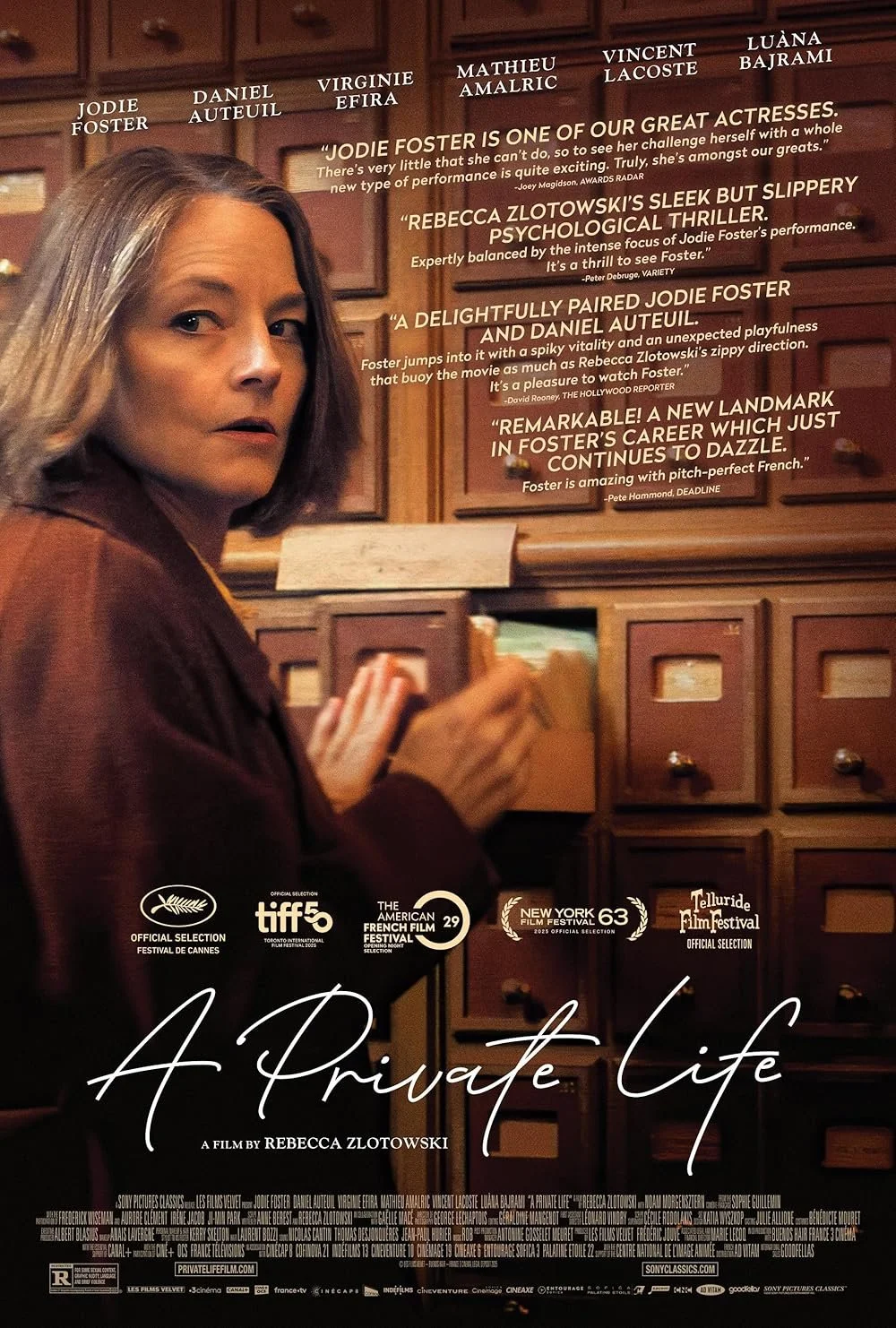
Dr. Lilian Steiner (Jodie Foster) resides in France as an American citizen whose lucky enough to have dodged residing in Trump’s America. One of Dr. Steiner’s patients has died. When attending the Patience funeral, she’s confronted by her infuriated husband, Simon Cohen-Solal (Mathieu Amalric), who demands that Lilian leave immediately as he blames the Doctor for malpractice.
The movie explores what it means to be a therapist and to live with guilt, knowing that you haven’t done enough. Were you too objective in treating a patient that you’re too blind to see and too deaf to hear when the patient is warning you that they could be a harm to themselves or other people? The top requirement for a therapist or social worker in mental health is ensuring the safety of others. You can’t cure depression, autism, or anything. The mind works differently from the body. All you can offer is treatment with no proven results. So what can you do when the limitations of your profession prevent you from hugging a patient or speaking to their family due to patient-doctor confidentiality?
Do those cold limitations turn the doctors themselves into disconnected people? We see that Dr. Steiner is not only distant from her patients but also from her family. She was too disconnected from her husband and her son. Maybe when you know what’s wrong with everyone's brains objectivley it’s hard to see how you begin to not care about other people.
This movie tackles some interesting subjects with a cool lens that feels almost as distant as an academic book on the mind. How Jodie Foster’s character handles grief and anger is merely interesting, but it lacks the drive to be fascinating. Call me a sensationalistic, short-attention-span American, but the movie is almost too much of a slow burn for its own good. It touches upon multiple points for an interesting yet disposable essay. It needed something singular to focus on.
The majority of the film is a murder mystery wrapped around the conspiracy that Dr. Steiner believes someone murdered her patient. When we get to the big reveal, it would have been far more dynamic if the film had sustained the tension of that scene in a Misery-like scenario. The film doesn’t have to go as far as Jodie Foster getting tortured by an enraged man, but something a little less subtle, where she’s stalked by that patient instead of her doing the stalking.
With more focus on a single psychological aspect or a little more thrill to the thriller, could the filmmakers really drive home their points about the extent to which a therapist can truly save a life. There’s simply not much for this film to leave itself to remember by other than Jodie Foster speaking fluent French for two hours.
A Private Life is playing in theaters now.