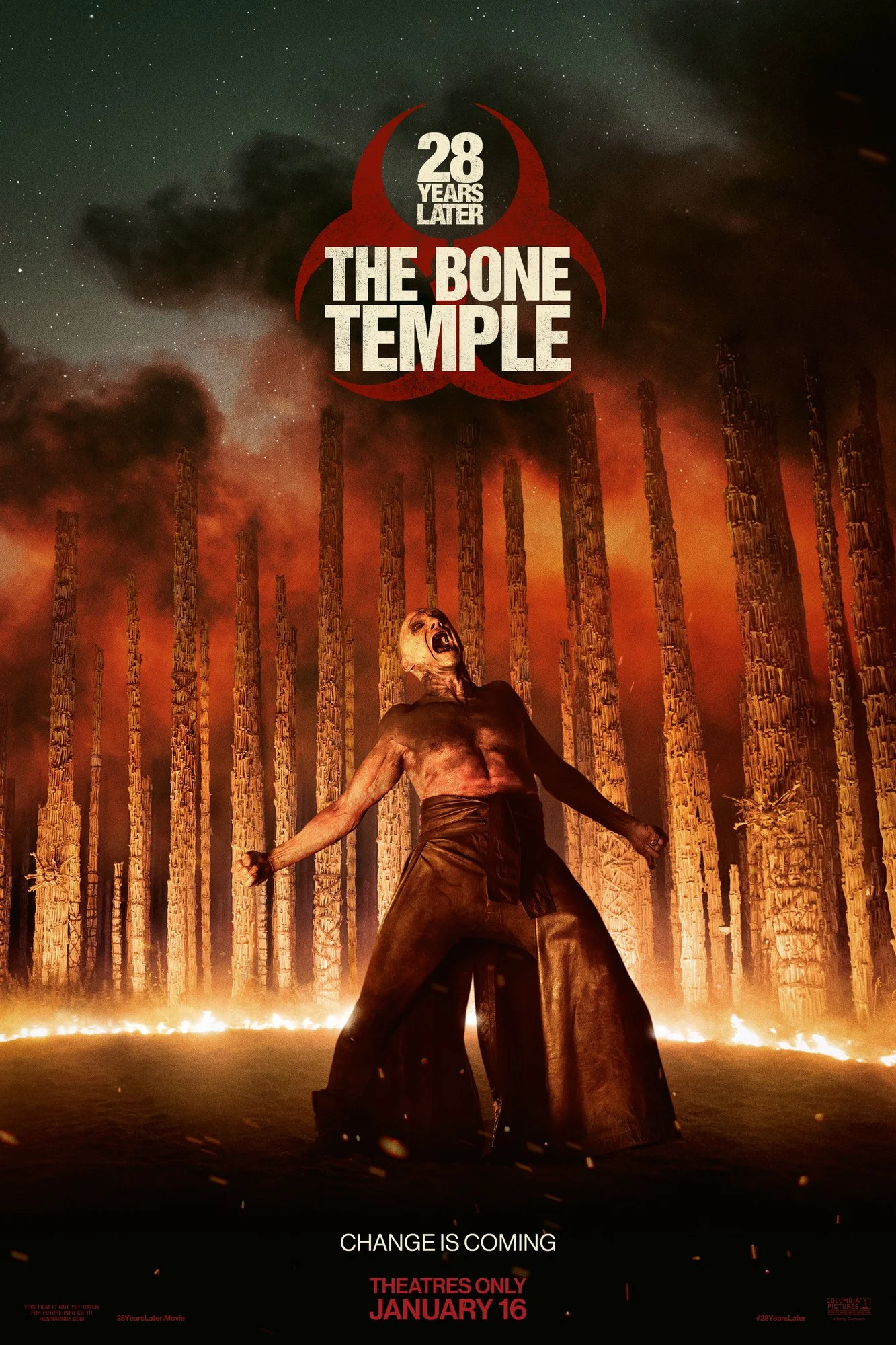
'28 Years Later: The Bone Temple'-Hate Done Effectively
The Alpha is back! But first, we return with Spike (Alfie Williams) and the Jimmy Saviles in an odyssey about hate. Yes, hate, that old theme that has been prevalent in zombie films since The Night of the Living Dead. Its message is communicated clearly. Violence is terrible, and tribalism only makes it worse. When the world should be uniting against a common cause, it devolves into man vs man warfare, dooming humanity to a never-ending loop of self-destruction.
If the majority of the film takes place in the island community of England, how did these guys survive for 28 years without the rest of the world's help? Why didn’t someone drone strike the infected? Drop medical supplies? Why make it a no-fly zone? How are people in the quarantine zone surviving only using arrows and hunting to survive? Where are the bullets? Did we run out of bullets and stick with arrows? How is everyone not malnourished?
The three-part sequel to 28 Days Later (28 Weeks Later is treated as if it never happened) is so rife with plot holes that it leaves the viewer feeling a tinge of rage at the lack of care for the small details. Still, with all of its logical loopholes and thematic similarities, the visceral strength of The Bone Temple’s shocking violence and empathetic heart is enough for it to be a worthy continuation of a solid sequel as long as you don’t see the ending.
28 Years Later: The Bone Temple is one of those sequels that requires you to see the first film to get what’s going on with this one. More specifically, you’ll be able to follow the overall plot. A drooling infant can follow its plot. When it comes to context, setting, and character motivation, that’s where previous picture knowledge is paramount. If you don’t know why everyone is dressed up like Jimmy Savile and why they’re having a galidotrial battle to the death in the opening five minutes, you might be lost. You won’t know who Dr. Kelson (Ralph Fiennes) is or why Sir Jimmy Crystal (Jack O'Connell) is such a monster. You could cheat by looking up key scenes on YouTube, but that would still remove much of the meaning from the context. A lot of zombie films (yes, the 28 movies are zombie films even if the zombies aren’t actually reanimated corpses) focus their rage on tribalism.
The Bone Temple aims at religion. Jimmy worships “old Nick,” AKA Satan. Not because he lost his faith, but because his father was a God fearing Priest who welcomed the apocalypse when it came 28 years ago, instilling a warped sense of morals and beliefs in Jimmy when the end arrived. How the movie depicts hatred and violence is more effective than something like The Last of Us Part II. It’s not a repetitive Walking Dead episode that’s violence begetting violence.
This movie isn’t about how Jimmy becomes a cult leader. The opening of 28YL gives you all the information you need to fill in the blanks. Returning Days Writer Alex Garland is very aware of what other films have done. He’s avoiding the scene where Erin Kellyman is explaining how Jimmy recruited her. The world is a sad and terrible place. Trauma will turn a decent person into a monster who, like Darth Vader, still has a redeemable soul in there. It might be a cliché, but clichés exist because we are clichés in some respects. It’s up to the writer to give meaning behind the familiarity that can be broken down beyond the obvious sentiment on the screen.
Hate is not a particularly effective theme for a movie. People need hope. No matter how audacious it may seem. With only despair, one can easily write a suicide letter for the characters that, even during the zombie apocalypse, isn’t engaging to watch. Not only does the movie tackle the whole love/hate dichotomy, but it also builds upon the thought of empathetic madness. What if there’s a purpose to Dr. Kelson’s work beyond the fact that he lives in a temple made from the skulls of the dead, paints himself in iodine, and treats the infected like pets. Knowledge is not a blessing or a curse. It’s a gift that carries a profound weight few can bear.
Dr Kelson has forgotten what it was like to have loved ones or a certainty that, despite mankind’s divisiveness, we’re ultimately going to be okay the next morning. Kelson confronts his madness with acceptance. There’s no God. No devil. No reason. Just us. We must make the best of what little each of us has and not succumb to anger. Anger is temporary. It will shorten your life. But sadness is natural. Even beautiful if you accept death. It’s not a fact I necessarily agree with, but one that Dr. Kelson reasonably has. We see the payoff to his work in this film that might be a cliche, but the way it's used is solemn.
Stylistically, the film’s switch from iPhones replicating Boyle’s use of Mini DV on Days to give an updated, hyperdocumentary-like look is abandoned in favor of standard cinema cameras for a much slower, yet chilling continuation of the Years story. The switch from Danny Boyle to Nia DaCosta is more of a first down in the N Zone than a touchdown. DaCosta does what she can from the foundation that Danny Boyle built. DaCosta is more of a traditional, methodical filmmaker with commercial sensibilities. The result is an engrossing success. If not for that pesky ending.
Don’t worry. I won’t give it away. Danny Boyle already did that in multiple interviews a year ago. Now that I've seen the Bone Temple, it’s still confounding as to why. As divisive as Years’ ending was, it made sense to me. Jimmy Savile was a British icon adored by many. After his passing, it turned out he was turning in Jeffrey Epstein numbers of sexual assault. Children looked up to Savile. When that news came out, something from someone’s childhood turned into a sick nightmare.
Jimmy Crystal had a childhood that was destroyed due to the pandemic. The things he grew up on, Power Rangers, Teletubbies, all became weaponized nostalgia. It’s the only good thing that was left in his life. Instead of growing up or being educated, he’s stuck in a childlike state, unable to accept the present. Everything must be done for Old Nick. The ending to this film is sequel-bait nonsense. Hopefully, Garland and Boyle have a plan for the third part of this trilogy. Admittedly, this film feels more like an epilogue than a two-parter. But it’s a wonderfully deep one.