'Highest 2 Lowest's' Highs Overcomes Its Lows
Spike Lee has learned from his mistakes. The last time Spike adapted an Asian cinema film, we got the commercially and critically panned Old Boy. This time around, Spike takes a classic movie from across the globe and adapts it into a film that distinctly feels like a Spike Lee Joint. Which, Spike, I respect you, but can you please call it a Spike Lee film? I'm not smoking the movie. Spike's like the black Tarantino of filmmaking. Obnoxious, and loves to star himself in his movies so he can stroke his ego. Yet, there's no denying that he has a style and commentary that nobody else can replicate successfully.
Highest 2 Lowest is a remake of Akira Kurosawa's 1963 film, High and Low. The story of that film involves a shoe company CEO who gets entangled in an extortion scheme when his co-worker's child is held at ransom. If the CEO doesn't pay up the ransom, the kid dies. If he does pay, maybe the child will still be offed, but it's worth the chance of paying it to save his life. Instead of simply recreating the original film's plot, Lee takes his own direction, where the film is more about a person rediscovering what they're passionate about, rather than just making another child abduction flick.
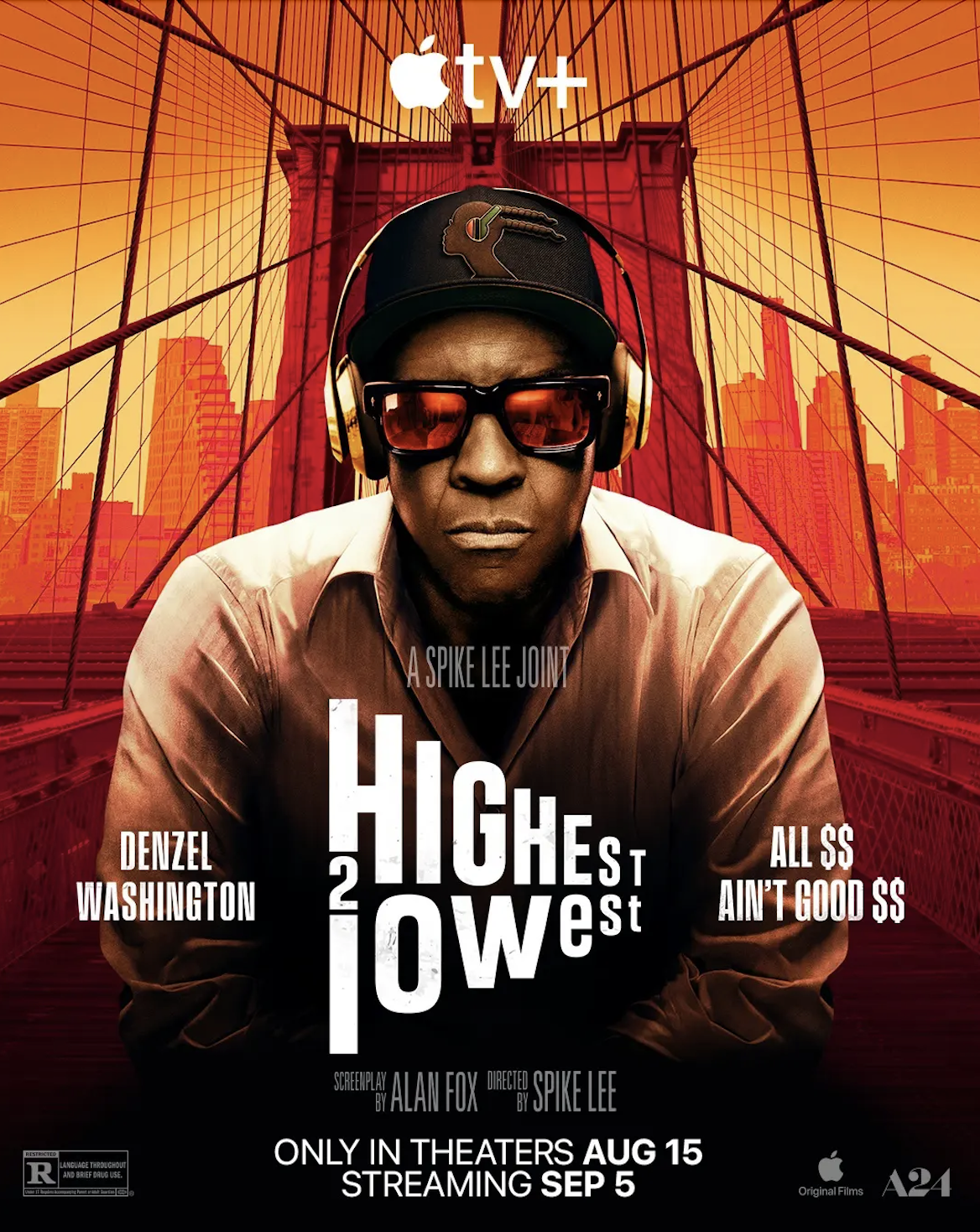
The movie is about a music mogul, David King (Denzel Washington), who's on the upswing in life. Except there's one thing missing. He's losing his passion for music. It's all about social media gathering clicks, rather than the art, which comes off as a bit like Spike being an old man trying to tackle an evolving world that goes beyond his comprehension. At first, at least. Social Media is a topic filmmakers handle a little too frequently these days, where they're all making the same point. Yet, with a tectonically shifting culture, it's understandable how directors struggle to discuss a world that's unraveling before them. When the movie reaches its conclusive, explosive ending monologue, which is shot like a split-screen phone conversation, the idea of clicks winning over decency resonates with searing force.
The film carries Spike's racial bite while not feeling like his usual middle finger to the white man. Considering how evil white people can be, I can't blame the guy for being so infuriated. The abductor in this film snatches Denzel's limo driver's son. To test David King's measure of character, he requests that King give him $17.5 million, or he'll execute the kid. Instead of doing the right thing, David hesitates, as that $17.5 million will expand his empire, making him even richer.
In contrast, Kurisowa's film hints at the protagonist being heartless, while Lee's film goes full Ebenezer Scrooge. Mr. King not only refuses to pay the money but also angrily lectures the missing boy's father, Paul (played marvelously by Jeffrey Wright) why he's sick of people constantly leeching off of him. There's also a scene where Denzel almost violently threatens a family member because they yell at him to pay the money. Even Mr. Scrooge would tell David to take it down a few notches.
Although child abduction is a deadly serious issue, the movie has clever humor to it that surprisingly doesn't feel out of place. One joke that my old brain couldn't help agree with is when one of the cops aiding David (played by Dean Winters) exclaims that all modern rap sounds the same. There's also an effective State Farm joke. What doesn't work is an intrusive third-act music video fantasy that lasts five minutes, completely breaking the rhythm of the picture.
By the film's conclusion, it takes a wildly different direction than the original, yet it works. The film's transition from a thriller to a commentary on modern-day music could have been clumsily handled, but the way it ties into the plot is fitting. The abductor, Yung Felon (A$AP Rocky), is your stereotypical young black man who perpetuates misconceptions of the black community. His grammar is terrible, he wears a hoodie, is a menace to society, and wants to be a rapper. Instead of pursuing an education that would enable him to gain an honorable profession, Felon creates generic music that anyone can do, where a mass audience will never notice him. He's one among millions who won't have a real career in music because too many people want to become famous instead of being doctors, teachers, or lawyers.
For his actions, Felon is rewarded instead of punished. A commentary from Spike about American culture honoring felons rather than punishing them. As long as you're famous, there will be a group of people who will love you no matter what you do. The picture features Spike's usual bag of tricks, which plays on a mixed level. On one hand, it's the mark of an auteur, yet on the other, it's melodramatic. During many key moments of the film, Howard Drossin's dramatic score drowns out crucial dialogue, thereby robbing the audience of any emotional connection. Maybe that's not a bad thing, as some of the lines are on par with George Lucas's cheesy writing. Subtlety is not Spike's forte.
Sometimes his hammer-smashing metaphors work. At other times, it comes across like a weekday soap opera. Even some of the production design is very basic, featuring generic red walls and lamps that resemble those from The Room. Yet most sets are intricately designed. Some shots also don't match in the color department, where it's evident that the DP switched lenses. Minus the technical flaws, it's nice to see a movie that isn't overly reliant on basic shot selection and musical choices. Spike's use of a wide depth of field, street-level dialogue, and harsh contrast ratio makes for a thriller that has that Spike Lee Joint quality you can't get from anyone else. Highest 2 Lowest isn't just another remake. It's a message about a degrading modern culture where musical talent and compassion need to be reborn.

Highest 2 Lowest releases in theaters nationwide this Friday for a limited time, then will premiere on Apple TV+ on September 5.

