'28 Years Later' Is Insanely Good
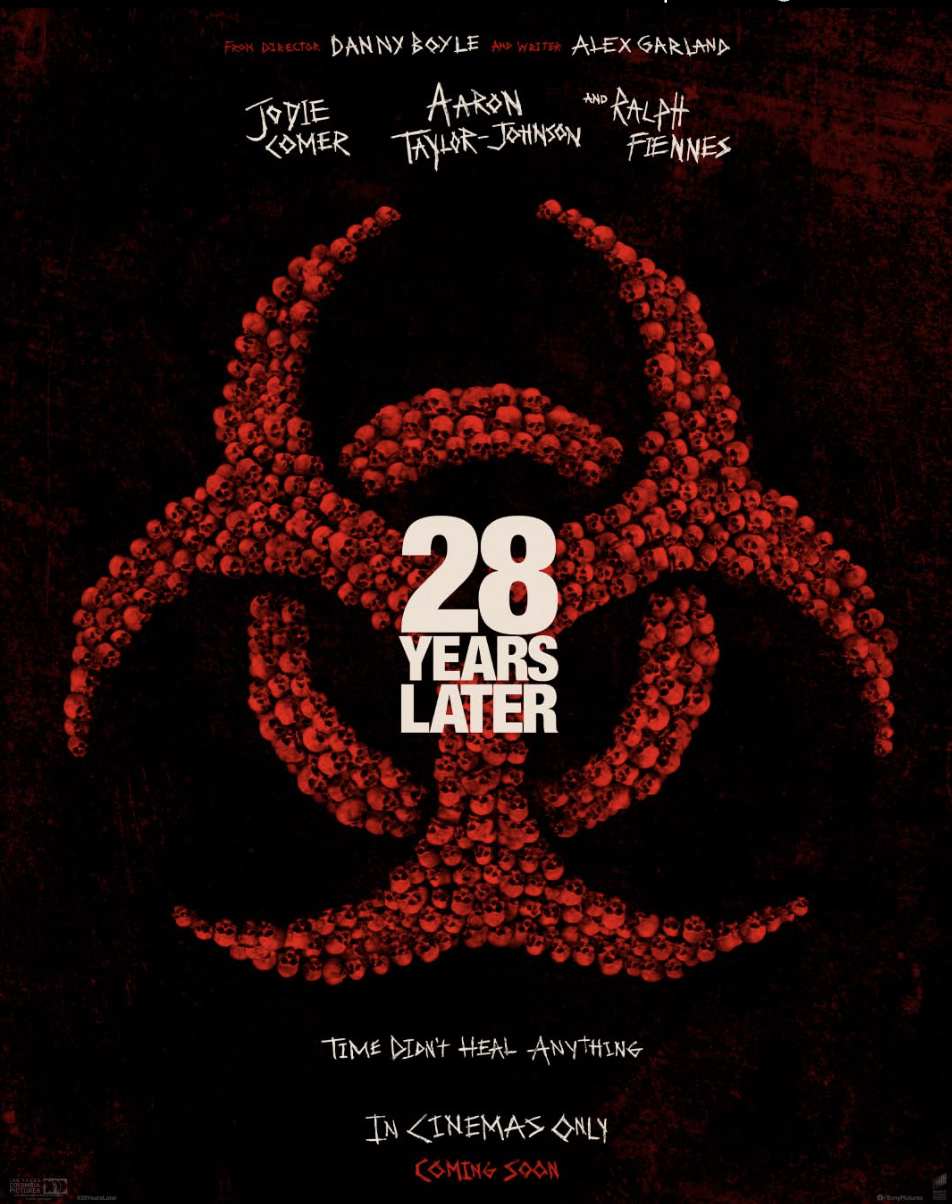
They pulled it off! Director Danny Boyle and Screenwriter Alex Garland reunite to make a sequel to 28 Days/Weeks Later that's disturbing, visceral, and surprisingly heartfelt. It's not the type of sequel you'd expect. The film shares a similar stylistic approach to 28 Days Later, but its story is scaled down rather than the usual sequel tactic of making everything bigger. 28 Years Later carves out a path as its own film, one that could be compared to the original, yet shouldn't be, as it's not a carbon copy of the previous material. It does what other sequels dare not do: be original.
28 Years Later starts in a very unexpected place. Anticipating a montage of the world falling apart, the movie begins with an episode of The Teletubbies that a group of kids are watching. Within less than a minute, chaos unleashes in a scene that doesn't hold back on taking any chances. In fact. This film is so graphic that it makes the first one look like The Teletubbies. It would be shocking if this movie didn't have to undergo multiple passes through the MPAA ratings board. There are guts, head rippings, and lots and lots of naked infected. Did I say lots? I meant all of them. This movie contains more genitalia than Shortbus. Yet, it's scary. Seeing a dirt and blood-covered naked corpse makes the zombies in the film appear more alien and menacing. Plus, they can't wear the same clothes for 28 years. Can they? Or did they just tear them off like a drug addict going through an intense trip?
The infected have evolved into different forms. Some are bigger yet slower, others are thinner and faster. The main baddy in this one carries a strength greater than the others. None of the nudity or violence feels gratuitous. It all exists to serve the purpose of displaying a sort of hyper-reality, which is what made 28 Days Later memorable in the first place.
That film succeeded due to its low-budget approach. The picture was famously shot on mini-DV cameras, giving it a documentary-like feel. The camera jerks and cuts frequently, like a camera operator on the run; yet, the angles are fantastic, and not every shot is handheld. Many sequences were expertly placed on dollies, steadicams, and cranes. The camera is everywhere because those DV cams can be placed anywhere, unlike bulky film cameras. Now, it's commonplace to put a camera in any location you please due to the evolution of digital cinematography.
28 Weeks Later attempted to capture a more conventional approach, where the movie was shot on film but was almost entirely handheld, unlike the original, lacking the angles and variety of the first one. Plus, it upped the scale. All factors that led to a decent but mediocre sequel. With the return of Danny Boyle, Danny goes low budget again. He shot the film on a rig that held multiple iPhones. Some sequences were shot on 20 phones. Others with 10 or fewer. Cameras were placed everywhere, even on farm animals (which didn't make the cut).
The look of the film is an evolution from the DV cams of the original. On the small screen, you'll never notice the difference. Every trailer online won't give you the lived-in feel you'll get from seeing it on the biggest screen possible. You won't see the grains, the intentionally out-of-focus actors, or scan your eyes across the canvas for a sneaking zombie. It simply looks unlike any other large studio release film that has come out in years.
Couple the cinematography with Danny Boyle's use of licensed music, freeze frames, and montages done in a psychedelic way that only Boyle can achieve. One particular sequence features black-and-white footage of British soldiers marching, interspersed with our main characters heading toward an infected zone. At the same time, Rudyard Kipling's poem "Boots" is being read aloud from an old radio recording. It's not only meant to be unsettling; it represents how everyone in this world has been formed into soldiers suffering from PTSD. They're always at war, walking, one step at a time, toward their death like soldiers marching endlessly with the sound of their boots haunting the narrator. Suffering from war, the people who are still in quarantined zones 28 years later have gone mad.
The film's resonant themes about insanity are palpable. Our main character, Spike (played with great depth by Alfie Williams), is a child who is extremely mature for his age. After returning from a successful infected hunt with his dad, Jamie (Aaron Taylor-Johnson), Spike enters a brothel where he's grandly celebrated for his triumph. Everyone there is having almost too much fun. Jamie feeds Spike alcohol despite him being just a boy. Everyone in the brothel is so rowdy that they're almost animalistic, like the infected themselves. Soon, we discover that Jamie isn't such a great dad after all, forcing Spike to take his ailing mother, Isla (Jodie Comer), to a doctor who can provide her with treatment. Everyone warns Spike that Dr Kelson (Ralph Fiennes) is insane. Yet, Spike takes the chance to bring her anyway.
Unlike most zombie films, including the original, this isn't your stereotypical "humans are the real monsters" type of story. Yes, there's division, but not full-on civil war like most zombie material (including 28 Days Later) usually has. It's more about how we break and lose our minds, harming ourselves. Not how we kill each other. Insanity can take many forms. Something Spike learns throughout the story. The movie's final moments are some of the darkest you'll see in a mainstream film for a very long time. Amazingly, it goes as far as it does, but it's earnest in its message. On top of insanity, the film talks about accepting death. We're terrified of it, but it's something we must all face. From burying others to being buried ourselves, it's unavoidable. How that theme resonates is grim and powerful.
28 Years Later isn't perfect. Some glaring plot holes will have you scratching your head. Especially one key decision from Spike that makes no logical sense. The film also acts like 28 Weeks Later never even happened. How did that movie depict the infected storming Paris, yet in this flick, the UK is the only place that's infected? Alex Garland said in an interview that Paris was nuked, preventing the spread, but since it wasn't on screen, I call that an artful dodge. Also, in one scene, a character pulls out an iPhone. The infection happened in 2002, so how did a piece of technology from 2007 wind up in a quarantined zone? Delivery drones?
These are minor grievances to be had with a film that is otherwise fantastic. After this movie, there are supposed to be two more. Something I don't feel is necessary. Just make it an anthology-based TV show at that point. Don't ruin something good, Danny. You can only outrun making a bad sequel for so long. Let Trainspotting 2 be proof of that.