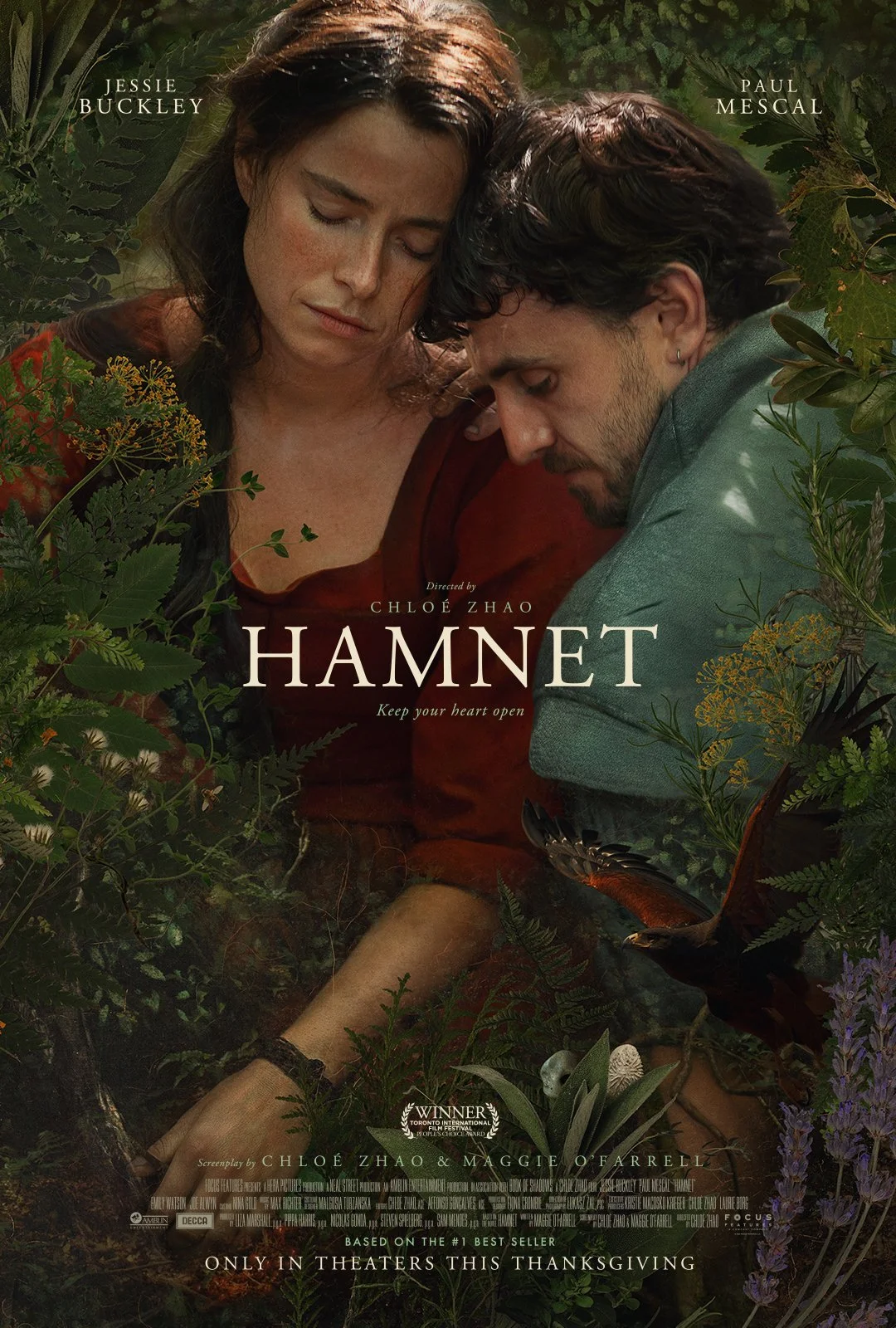
Why 'Hamnet' Will Break and Repair Your Heart
Whether you're a fan of William Shakespeare or not, Hamnet will leave you with profound admiration and a broken heart for him. This isn't your typical Oscar-bait Shakespeare film. It's not the adominbal Shakespear in Love that won the Academy Award over Saving Private Ryan because Harvey Weinstein was the king of Hollywood at the time. That bad taste of a decision never gets out of your mouth. Hamnet is much deeper than a typical Romeo & Juliet derivation or an uplifting tale about a loving artist. Hamnet will lift your spirits, but not in the way you'll expect.
Before the movie reaches its rousing conclusion, be ready for an exercise in extreme misery. Hamnet is a tale that will not only break your heart. It will tear it out of your stomach, kick it around the room like a soccer ball, dump it in the trash, take it out of the garbage, clean it, and then place it back in your chest. It's an exercise in grief that makes you feel like you're actually grieving someone. It's not like most movies where a terrible death happens, everyone cries for a scene or two, then plows on with the rest of the story. Here, death lingers the way it does in reality.
When a child loses a parent, even worse, a parent loses their kid, that pain will never escape. No matter how much money you have, it can't replace an essential part of your life. It's a part of you that you'll never get back. A lot of movies make this point by saying it outright in the dialogue, but how many actually make us feel that absence of life?
Death is a major part of the story in almost every movie throughout history. This movie feels like you're sitting through a two-hour funeral. Whatever criticism you may have of Director Chloé Zhao, whom I have been very harsh on, you owe it to yourself to check out this picture. Zhao knows how to tap into people's emotions like nobody's business. People in this movie are neither saints nor sinners. They're merely flawed individuals who are lost, trying to navigate life like the rest of us.
Where most movies about Shakespeare portray him as an angelic lover, Chloé Zhao presents him with honesty. If William Shakespeare (Paul Mescal) had behaved the way he did at the beginning of the movie, he might have been slapped or arrested when the cops arrived on their carriages. But he's good-looking looking so he can get away with being a creep. When he first meets his future wife, Agnes (Jesse Buckley), the first thing he says to her is that he won't get her name unless she kisses him, then gets close to her face. If a person who looked like me tried to introduce myself that way, I'd probably have permanent groin damage from a powerful kick to my twins. The average-looking folks to ugos have to put in extra effort to hook up.
Upfront, the movie's being honest. Will is a bit of a pervy stalker. Even at one point, when Will sees Agnes, she tries to tell him to disperse, as he almost won't take no for an answer. People shouldn't take their romantic ideas from movies unless they want to end up in handcuffs.
William's home life is not the luxurious lifestyle of the most prolific playwright of all time that you would imagine. He lives with his toxic family. His father is strict, while his mother is even worse as she's a God fearing Bible thumper. There's hostility between his siblings, and it takes a while for Agnes and Will's mother (Emily Watson) to adjust to one another. The tiny community Will resides in is a prison he must escape from. If it were not for Agnes pushing him to move to London, the world might never have experienced William Shakespeare's work.
Although this movie is based on the inception of Hamlet (Hamnet was an interchangeable name in the late 15th-early 16th century), it's just as much about Agnes as it is about William. Paul Mescal gives an Oscar-worthy performance filled with pain, anger, and compassion, but it's Jesse Buckley who completely blows the doors wide open. Not to give her serious consideration for an Oscar would be a Shakespeare in Love-level travesty that should never be repeated. Buckley has to cover almost every range of emotion, yet she must deliver it without simply shouting or crying. Anyone can do that. Maybe not produce tears. That's what teardrops are used for on set. Tom Cruise needs them all the time. Acting comes from having the audience read what you're feeling on the inside. Buckley's face is a portrait of anguish. You can tell exactly what type of insufferable agony Agnes is experiencing without her having to utter a single word. Acting is not just about line delivery; it's also about reacting.
As someone who often rails against cinema's over-reliance on digital, Chloé Zhao is one of the few filmmakers who make the use of the medium more intentional than cost-effective. Zhao likes to take advantage of digital's broader light range compared to celluloid. It's the one thing digital has over film. Despite its inferiority to black-and-white levels, depth of field, and movement, digital can handle whatever light you can throw at it as long as you know what you're doing. In Nomadland and The Eternals, Zhao was just trying to use as much natural light as possible, which led to much of her work being underexposed.
You could argue that the dark screen is intentional, but bad cinematography is bad cinematography. Zhao's earlier work looks like something an art school student would shoot, thinking they're being original with all-natural light, when in actuality, they just don't want to go through the setup time for the gaffers to do their job. With Hamnet, Chloé has finally learned how to utilize the camera, and the results are stunning. The lighting makes you feel how cold and sad the middle of England is. Digital exists for movies like this, proving its value in cinema.
For a common fool like myself, unable to even comprehend most of Shakespeare's old English, Hamnet profoundly makes you understand his work. The best art comes from pain. We use art to communicate emotions we share with people from all over the world, no matter how different their culture might be. As Renowned Hollywood editor Walter Murch once said, cinema is a meeting of the eyes. When the film exchanges its final glances, you might feel frog in your throat and bucket of water in your eyes. In gaining success, William lost everything. But it mattered in the end. It gave him and his family a reason to live. Hamnet understands what it's like to power through pain, to maintain your dignity, to ignore your guilt, and to face your past, in a spectacular work of art that's easily one of the best pictures of the year.


